


- What Is Landing Page Split Testing
- Why Landing Page Split Testing Matters for Conversion Growth
- High-Impact Areas You Should Test on a Landing Page
- Step-by- Step Framework to Run a Landing Page Split Test
- Common Landing Page Split Testing Mistakes
- How to Run Faster Landing Page Experiments on Shopify
- Landing Page Split Testing for Paid Traffic (Advanced Use Cases)
- Conclusion
- FAQs about Landing Page Split Testing
Landing pages are where your traffic turns into revenue. But for many Shopify merchants and performance marketers, the landing page is also where conversion drops without a clear reason.
You update the headline, adjust the CTA, or even redesign the entire layout. Sometimes performance improves, sometimes it doesn’t. The problem is not the effort, but the absence of a structured method to validate what actually works.
Split testing for landing pages gives you that structure.
Instead of making changes based on assumptions, you run controlled experiments to see how real users respond. Each variation becomes a data point, helping you understand what drives clicks, engagement, and ultimately, purchases.
In this guide, let’s explore how to run landing page split tests that lead to measurable, scalable growth.

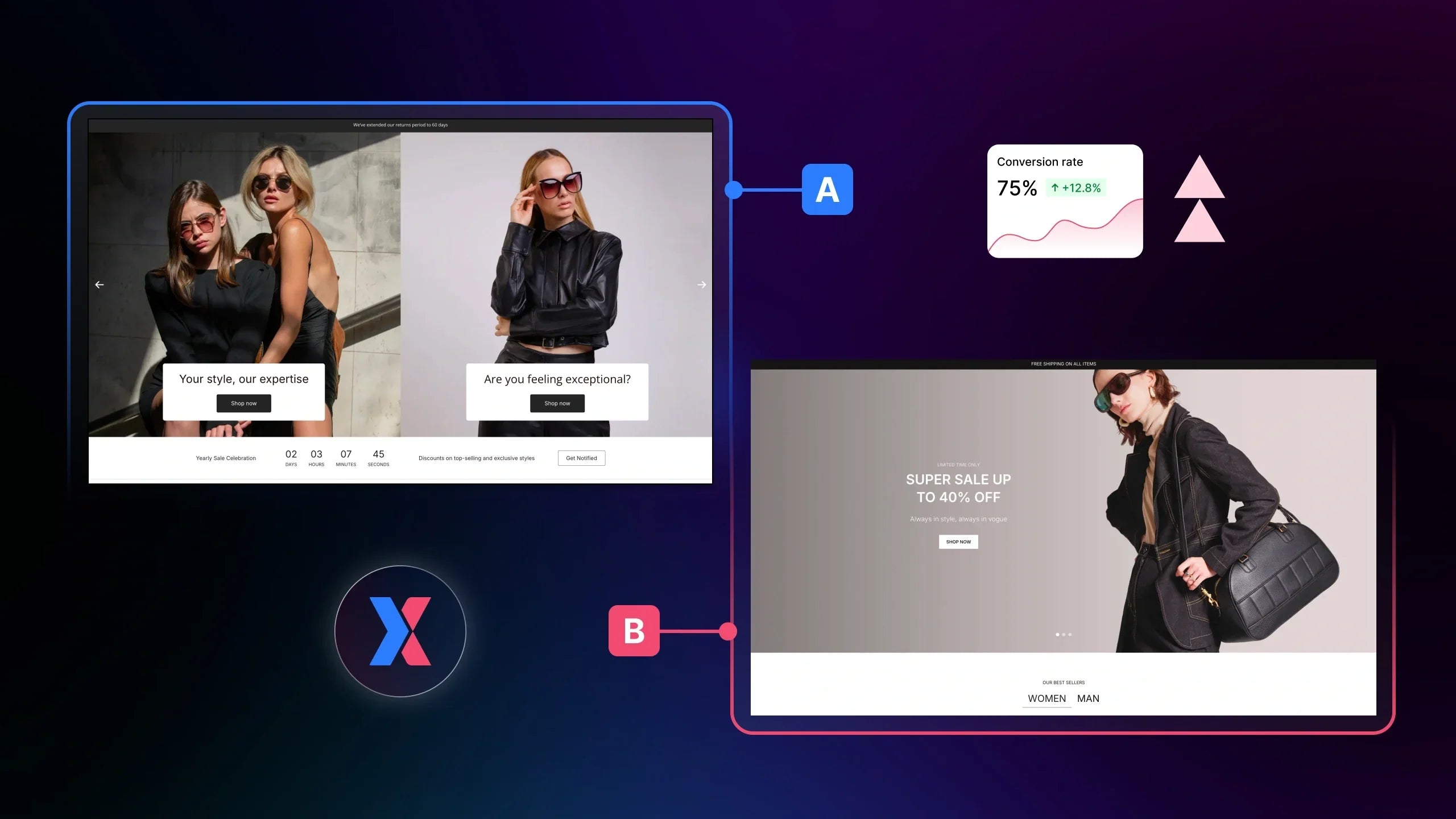
What Is Landing Page Split Testing
Landing page split testing is a method of comparing two or more versions of a landing page to see which one performs better based on real user behavior.
Instead of making changes and hoping for improvement, you divide your traffic into separate groups. Each group sees a different version of the page. Their interactions, such as clicks, conversions, and revenue, are then measured to determine which version delivers better results.
In most cases, you’ll work with two versions:
-
Version A (Control): your current landing page
-
Version B (Variation): a new version with a specific change (headline, CTA, layout, offer, etc.)

Traffic is split between these versions, typically 50/50, so the comparison stays fair and unbiased.
The key difference between split testing and simply editing a page is validation. Every change is tested in isolation, so you can clearly attribute performance differences to a specific element, not guesswork.
If you run your store on Shopify, this process is often referred to as A/B testing, where experiments are used to validate ideas before rolling them out at scale.
At its core, landing page split testing turns your page from a static asset into a continuous optimization system, one that improves over time with every experiment.
Why Landing Page Split Testing Matters for Conversion Growth
1. It directly impacts revenue, not just UX
Landing page split testing is not about making pages look better. It’s about making them perform better.
Every variation you test affects how users interact with your page, from clicking a CTA to completing a purchase. With landing page testing, you can measure how each change contributes to actual revenue, not just visual improvements.
This is what separates design updates from real conversion rate optimization for landing pages.
2. It improves core conversion metrics
When you run landing page A/B testing, you’re not guessing performance anymore. Instead, you’re tracking it through key metrics:
-
Conversion Rate (CR): how many visitors take action
-
Click-through Rate (CTR): how users engage with your content and CTAs
-
Revenue per Visitor (RPV): how much value each visit generates

By using split testing landing pages, you can identify which version improves these metrics and scale what works.
3. It helps you optimize every step of your funnel
Your landing page is where post-click decisions happen. If users drop off here, your entire funnel loses efficiency.
Testing for landing page optimization can help you enhance how users transition from landing to engagement and from engagement to conversion. This is especially important for paid traffic, where every click has a cost.
4. It maximizes the ROI of paid traffic
Running ads without optimizing your landing page creates a gap between acquisition and conversion.
With Google Ads landing page A/B testing or social campaign experiments, you can align your landing page with user intent after the click. This reduces bounce rate, increases conversions, and improves overall return on ad spend.
Landing page split testing ensures your traffic investment delivers measurable returns.
5. It builds a scalable growth system
Split testing for landing pages turns optimization into a repeatable process.
Instead of making one-off changes, you continuously test new ideas, validate results, and apply winning variations. Over time, this process creates a system where each experiment contributes to long-term growth.
That’s how teams move from isolated tests to a structured landing page optimization testing strategy that scales with their business.
High-Impact Areas You Should Test on a Landing Page
Not all elements on a landing page contribute equally to conversion performance. If you want your landing page split testing efforts to drive real impact, focus on the areas that directly influence user decisions.
Below are the highest-impact elements to prioritize when split testing landing pages:
Headline & Value Proposition
Your headline is often the first thing users see and the first decision point.
It determines whether visitors stay, scroll, or bounce. Therefore, even a minor change in phrasing can greatly influence the clarity of your offer.

When running landing page A/B testing, test:
-
Clarity vs Creativity
-
Benefit-driven vs Feature-driven messaging
-
Different angles (discount, outcome, urgency, differentiation)
The goal is to align your value proposition with user intent as quickly as possible.
Learn more: How to A/B Test Multiple Headlines and Boost Your Conversions
Hero Section (Above-the-Fold)
The hero section sets the tone for the entire page. It combines your headline, visuals, and initial CTA into one critical experience.
Through landing page optimization testing, you can experiment with:
-
Static images vs Product-focused visuals
-
Lifestyle imagery vs Functional demonstration
-
Layout structure (text-left vs text-center)
-
Supporting copy that reinforces the main message
This section has a direct impact on engagement and scroll behavior.
CTA (Copy, Color, Placement)
Your call-to-action is where intent turns into action. Even small adjustments in CTA design can influence click behavior.

With landing page split testing, you can test:
-
Copy (e.g., “Buy Now” vs “Get Started”)
-
Color contrast and visibility
-
Placement (above-the-fold vs repeated sections)
-
Size and prominence
Optimizing CTAs is one of the fastest ways to improve both CTR and conversion rate.
Social Proof & Trust Signals
Users look for reassurance before taking action, especially on cold traffic. By split testing landing pages, you can evaluate how different trust elements affect conversion:
-
Customer reviews vs Testimonials
-
Star ratings vs Detailed feedback
-
Trust badges, certifications, or guarantees
-
Placement of social proof (near CTA vs separate section)
Strong social proof reduces hesitation and increases confidence in your offer.
Offer & Pricing Structure
Your offer is often the final trigger for conversion. Through landing page A/B testing, test how different pricing and incentives influence user decisions:
-
Discount vs Value-based messaging
-
Bundles vs Single product offers
-
Free shipping thresholds
-
Limited-time offers or Urgency cues

Even slight adjustments in how the offer is presented can lead to measurable differences in revenue.
Learn more: To see how these elements perform in real scenarios, refer to these split testing examples and how different variations impact conversion outcomes.
Step-by- Step Framework to Run a Landing Page Split Test
Making random changes doesn’t lead to a successful split test for a landing page. Instead, you should go with a structured process that ensures every result is reliable and actionable.
Here’s a practical framework you can use to run landing page A/B testing with confidence:
Step 1: Define a Clear Hypothesis
Every test should start with a specific assumption you want to validate.
This hypothesis needs to be grounded in data. You can use insights from analytics, heatmaps, or previous test results to identify where users drop off or hesitate.
A strong hypothesis typically follows this structure:
| If we change [element], then [expected impact], because [reason based on data]. |
This keeps your landing page optimization testing focused and measurable.
Learn more: 70+ Strong Hypothesis Examples for Better A/B Testing
Step 2: Create One Focused Variation
When split testing landing pages, clarity is everything.

For example, we'll change the CTA copy only: "Buy now" vs. "Get Yours Today - Free Shipping"
Avoid changing multiple elements at once. If you update the headline, CTA, and layout together, you won’t know which change influenced the result.
Instead, create one variation with a single, clear change. This allows you to isolate impact and build reliable insights for future tests.
Step 3: Split Traffic Properly
To get valid results, your traffic needs to be distributed evenly between variations.
Most landing page split tests use a 50/50 split to ensure a fair comparison. This minimizes bias and ensures both versions are tested under similar conditions.
Consistent traffic allocation is critical for maintaining data accuracy.
Step 4: Measure the Right Metrics
Not all metrics reflect real performance. When running landing page A/B testing, you should focus on metrics that directly tie to business outcomes:
-
Conversion Rate (CR)
-
Click-Through Rate (CTR)
-
Revenue or Revenue per Visitor (RPV)
Avoid relying on vanity metrics that don’t translate into actual growth. The goal is to understand which variation drives better results, not just more activity.
Step 5: Analyze Results and Declare a Winner
Once your test has collected enough data, it’s time to evaluate performance.

The key you should remember is always looking for meaningful differences between variations, not short-term fluctuations. Also, avoid ending your test too early that can lead to incorrect conclusions and “false winners.”
A structured analysis ensures your split testing of landing pages leads to decisions you can confidently scale.
Learn more: If you want to go deeper into how to structure experiments and interpret results, explore this CRO framework for Shopify to build a more systematic testing approach.
Common Landing Page Split Testing Mistakes
Even well-planned split testing of landing pages can fail if execution is off. Here are the most common mistakes when splitting testing landing pages, and how to fix them:
|
Mistake |
Why It Hurts |
How to Fix |
|
Testing too many changes at once |
Makes it impossible to identify what actually impacts performance |
Test one variable at a time for clear, actionable insights |
|
Ending tests too early |
Early results fluctuate and don’t reflect real user behavior |
Run your landing page A/B testing long enough to collect reliable data |
|
Ignoring statistical significance |
Small differences may happen by chance, not a real improvement |
Validate results with consistent trends before making decisions |
|
Choosing false winners |
Short-term spikes can lead to incorrect conclusions |
Evaluate across multiple metrics like CR, CTR, and revenue |
|
Testing without a clear hypothesis |
Leads to random experiments with unclear outcomes |
Start every landing page optimization testing with a data-backed hypothesis |
This format keeps your split testing insights for landing pages easy to scan, easier to remember, and more actionable.
How to Run Faster Landing Page Experiments on Shopify
Running effective tests for landing page splits often breaks down at execution. Test ideas take days (or weeks) to launch. By the time a variation goes live, the opportunity is already gone.
This is exactly where GemX: CRO & A/B Testing changes the game, purpose-built for landing page A/B testing on Shopify, with a focus on speed, control, and measurable results.
No-Code Setup: Launch Tests Without Developer Bottlenecks
Traditional split testing for landing pages usually requires technical setup, especially when creating variations or modifying layouts.
With GemX, you can:
-
Create and edit landing page variations visually
-
Duplicate existing pages and apply changes instantly
-
Launch tests without touching code
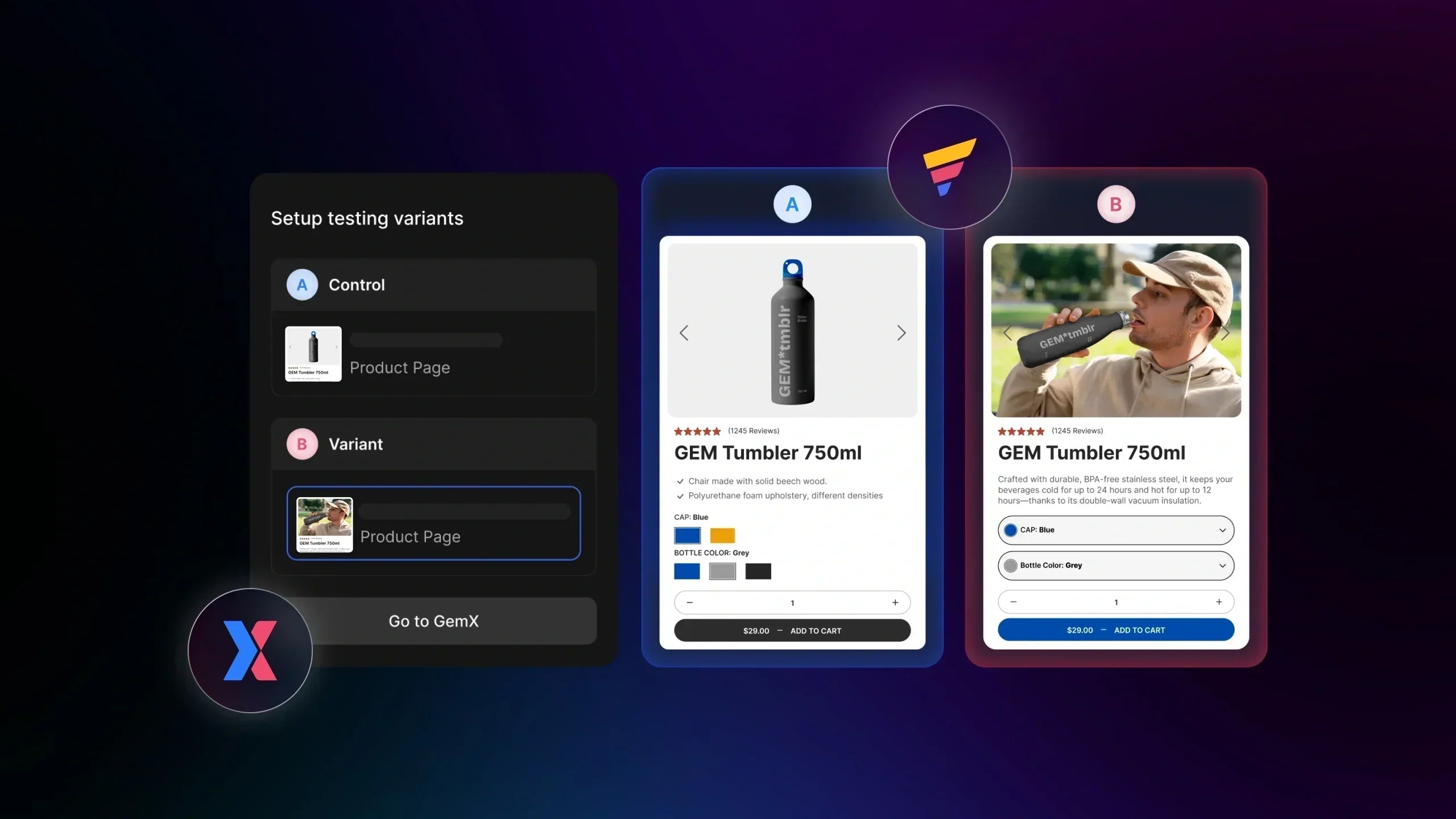
This removes the biggest bottleneck in landing page optimization testing, dependency on dev resources.
Instant Traffic Split: Run Clean, Controlled Experiments
Accurate results depend on how traffic is distributed.
GemX allows you to:
-
Split traffic between variations with precision (e.g., 50/50 or custom ratios)
-
Ensure consistent user distribution across versions
-
Maintain clean experiment conditions for reliable comparison
This ensures your results from landing page split testing are valid and actionable.
Real Revenue Tracking: Measure What Actually Matters
Many tools stop with clicks or conversion rates. But for real growth, you need to understand revenue impact.
With powerful built-in analytics, you can:
-
Track orders generated from each variation
-
Measure revenue per variation in real time
-
Identify which version drives actual business results

Using GemX, you turns landing page A/B testing into a revenue-driven decision system, more than just a UX exercise.
Faster Iteration Cycles: Test More, Learn Faster
Speed is a competitive advantage in CRO. GemX enables you to:
-
Launch experiments quickly
-
Iterate based on real data
-
Scale winning variations without delay
And the result? You’ll get a continuous landing page split testing workflow that compounds over time.
Built for Shopify: No Workarounds Needed
Unlike generic tools, GemX is designed specifically for Shopify merchants. That means:
-
Seamless integration with your store
-
No complex setup or external scripts
-
Testing workflows aligned with Shopify structure
You can focus on optimizing performance, not managing technical complexity.
Bottom line: If you’re serious about landing page split testing, the goal is not just to run experiments but to run them faster, cleaner, and with clear revenue impact.
That’s exactly what GemX is built for.
Landing Page Split Testing for Paid Traffic (Advanced Use Cases)
When you’re running paid campaigns, landing page split testing becomes even more critical. Every click has a cost, so improving post-click performance directly impacts your return on ad spend.
Instead of focusing only on ad creativity or targeting, high-performing teams optimize what happens after the click, where conversions actually happen.
Google Ads Landing Page Testing
Users coming from Google Ads often have a clear intent. They click because they expect a specific solution based on their search.
If your landing page doesn’t match that expectation, drop-off happens immediately.

With Google Ads landing page A/B testing, you can:
-
Align headline messaging with search intent
-
Match keywords with value propositions
-
Test different layouts for high-intent vs exploratory queries
The goal is to create a seamless transition from search → landing page, reducing bounce rate and improving conversion rate.
Learn more: For a deeper breakdown, explore this Google Ads landing page testing guide.
Facebook Ads Landing Page Testing
Traffic from Facebook or other social platforms behaves differently. Users are not actively searching; actually, they are discovering.
This means your landing page needs to continue the story started by the ad. Through split testing of landing pages, you can:
-
Align visuals with ad creatives (UGC, lifestyle, product demos)
-
Match tone and messaging from ad copy to landing page
-
Test different hooks for cold vs warm audiences
Pro tip: Consistency between ad and landing page helps maintain attention and increases the likelihood of conversion.
Post-Click Optimization Strategy
Most teams optimize ads but overlook what happens after the click. Landing page optimization testing allows you to improve the entire post-click experience:
-
Reduce friction between sections
-
Improve content flow and clarity
-
Guide users toward a clear conversion path
Instead of treating ads and landing pages as separate components, you optimize them as one continuous funnel.
Key takeaway: When done right, landing page split testing for paid traffic doesn’t just improve conversion rate. More than that, it increases the efficiency of every dollar you spend on acquisition.
Conclusion
Landing page performance doesn’t come from one perfect design. It comes from continuous testing, learning, and iteration.
Every headline, CTA, or offer you put on a page is an assumption until it’s validated. With landing page split testing, you turn those assumptions into measurable insights and those insights into real conversion growth.
This is how high-performing Shopify brands operate. Instead of relying on guesswork, they create a system that enhances each experiment, ensuring every decision is data-driven.
If you’re already investing in traffic, the next step is to make it convert better. That’s where structured landing page A/B testing makes the difference.
Ready to run your first experiment with GemX and turn your landing page into a scalable growth engine?
FAQs about Landing Page Split Testing


