


- Why Testing Landing Pages Has a Bigger Impact Than Testing Ads
- What Makes Google Ads Traffic Different
- What to A/B Test on a Google Ads Landing Page (High-Impact Elements for Paid Traffic)
- Step-by-Step Framework for Google Ads Landing Page Testing
- Running Landing Page Tests Without Developers
- Final Thoughts: Optimize Post-Click Before Increasing Budget
- FAQs about A/B Testing for Google Ads Landing Pages
Your ads aren’t the problem.
Your Google Ads are getting clicks, traffic is flowing, and TR looks solid.
But conversions aren’t scaling.
When that happens, most marketers assume the issue sits inside the campaign. They rewrite ads, test new creatives, adjust targeting, or increase bids. Sometimes performance improves slightly. Most of the time, it doesn’t move enough to matter.
Because the real bottleneck isn’t pre-click. It’s post-click.

Every paid visitor arrives with intent and cost attached. The moment they land on your page, your job is to confirm relevance, remove friction, and guide them toward a clear action. If your landing page fails to deliver instantly, high-intent traffic will bounce no matter how strong your ad is.
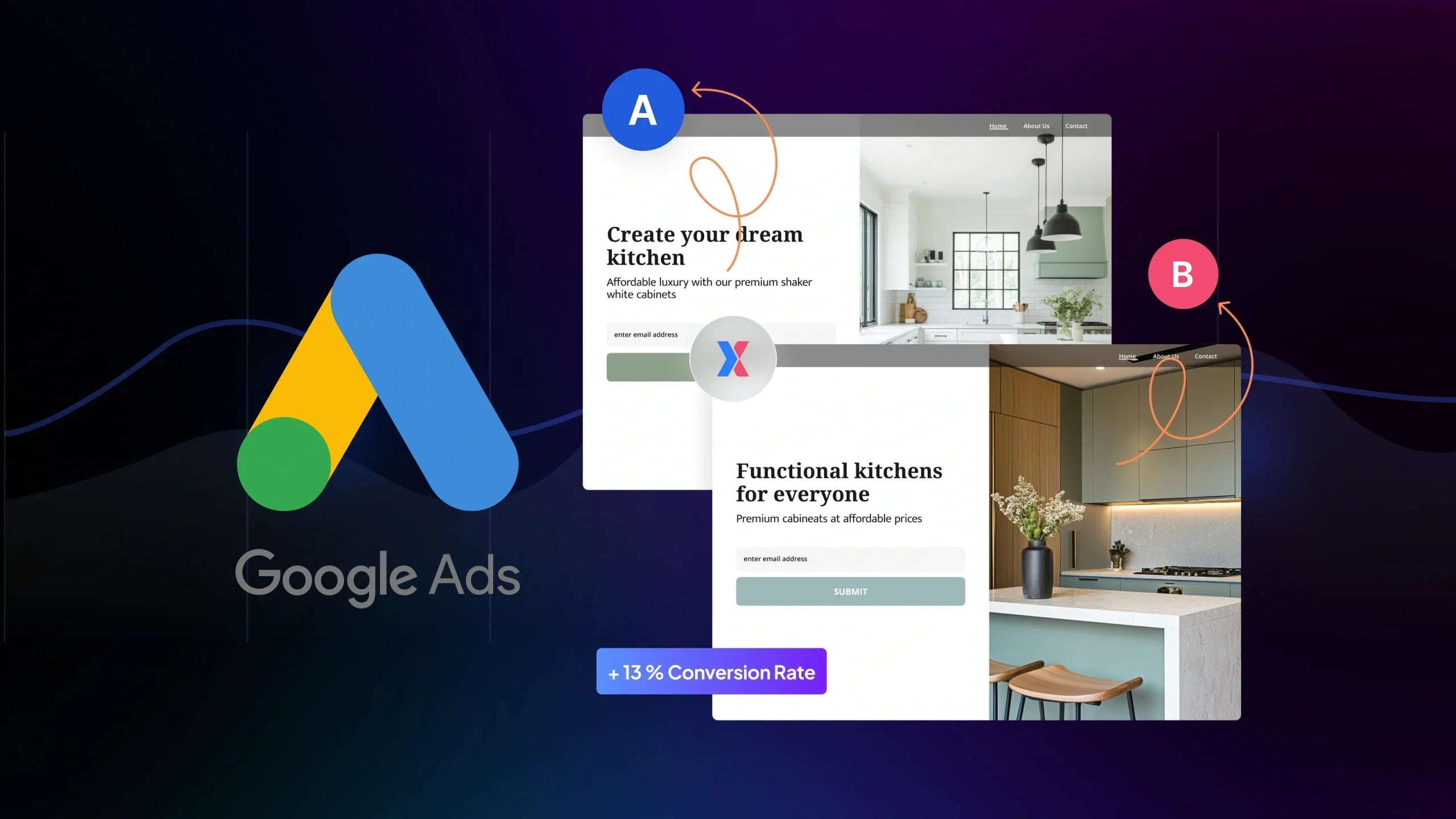
This is where A/B testing for Google Ads landing page becomes a growth lever. Instead of chasing better clicks, you focus on converting the clicks you already pay for. Even a small lift in landing page conversion rate can significantly reduce CPA and unlock scalable ROAS.
Before increasing the budget, let’s optimize what happens after the click.

Why Testing Landing Pages Has a Bigger Impact Than Testing Ads
Most teams spend the majority of their time optimizing ads.
They launch new creatives, test different hooks, experiment with new angles, and refresh headlines regularly. While those efforts are necessary, they often produce only incremental improvements.

The reason is simple: ad testing typically improves how many people click. Landing page testing improves how many people buy.
That distinction changes everything.
Ads Improve Clicks, while Landing Pages Improve Revenue
When you test ads, you’re usually optimizing metrics such as:
-
Click-through rate (CTR)
-
Cost per click (CPC)
-
Impression share
These improvements help you acquire traffic more efficiently. However, traffic alone does not generate revenue. Revenue is created when that traffic converts.
Your landing page directly influences:
-
Conversion rate (CR)
-
Cost per acquisition (CPA)
-
Return on ad spend (ROAS)
Unlike CTR, these metrics determine whether your campaigns are sustainably profitable. As a result, improving landing page performance often has a more meaningful impact on your bottom line than continuously refining ad variations.
This is precisely why strong Shopify conversion rate optimization strategies prioritize what happens after the click, not just before it.
The Math of Leverage
To better understand this, consider a simple example.
Assume you’re driving 10,000 clicks per month from Google Ads:
-
Conversion rate: 2%
-
Average order value: $100
-
Revenue: $20,000
Now, suppose you increase CTR by 10%. As a result, you generate 11,000 clicks instead of 10,000. Revenue may increase slightly if the conversion rate remains stable.
However, imagine instead that you increase the conversion rate from 2% to 3%.
With the same 10,000 clicks, you now generate 300 orders instead of 200. Consequently, revenue rises from $20,000 to $30,000 without increasing traffic or ad spend.
In other words, optimizing conversion rate amplifies every dollar you already invest in paid traffic.
Learn more: How to Test Landing Page for Paid Traffic Without Burning Ad Budget
Ads Testing Is Linear, while Landing Page Testing Is Multiplicative
Ad testing improves acquisition efficiency in a relatively linear way. You adjust creatives, improve CTR, and potentially reduce CPC. The gains are real, but they tend to be gradual.
Landing page A/B testing, on the other hand, enhances monetization efficiency. When your landing page converts better:
-
CPA decreases without changing bids
-
ROAS improves without raising budget
-
Scaling becomes more predictable
Instead of constantly pushing more traffic into the funnel, you strengthen the system that turns traffic into revenue. Google Ads landing page A/B testing is not simply another optimization tactic. It is often the fastest way to unlock profitable scale.
What Makes Google Ads Traffic Different
If you treat paid traffic the same way you treat organic traffic, your landing page will underperform. The psychology is different, the expectations are different, and the tolerance for friction is dramatically lower.
Understanding that difference is what makes Google Ads landing page A/B testing effective instead of random.
Intent Compression
Organic visitors often browse. They compare options, read multiple articles, and explore your site. In contrast, Google Ads traffic usually arrives with compressed intent.
Someone types a commercial keyword, clicks a paid result, and expects a clear solution immediately. They are not looking for exploration. They are looking for confirmation.
Because of that, your landing page has seconds to validate relevance. If the headline feels generic or disconnected from the query, the user leaves.
This is why message match testing should be one of your first experiments. The keyword that triggered the ad should clearly echo in the landing page headline. When alignment is tight, friction decreases and trust increases.
Low Patience and Bounce Sensitivity
Paid traffic is expensive. More importantly, it is impatient.
Users who click ads often:
-
Scan instead of read
-
Look for pricing or offers immediately
-
Decide within a few seconds whether to stay
If your above-the-fold section is unclear, cluttered, or slow to communicate value, bounce rate rises quickly. High bounce rates are often less about traffic quality and more about unclear positioning.

This is exactly why many teams start by learning how to A/B test above-the-fold sections before changing deeper page elements. Small improvements in clarity at the top of the page can produce measurable lifts in conversion rate for paid traffic.
Commercial Mindset vs. Informational Mindset
Organic traffic may arrive in research mode. Paid traffic, especially from bottom-funnel keywords, often arrives in buying mode.
That difference changes what matters on the page.
For commercial queries:
-
Clear pricing beats storytelling
-
Proof beats branding
-
Direct CTAs outperform vague exploration
If someone searches “buy ergonomic office chair,” they do not want a brand manifesto. They want reassurance, features, and a clear path to purchase.
When you A/B test landing pages for Google Ads, your experiments should reflect that commercial urgency. Test stronger offers. Test clearer CTAs. Test simplified layouts that reduce cognitive load.
The Continuation Principle from Ad to Page Alignment
A paid click creates an expectation. Your ad makes a promise. Your landing page must continue that promise without interruption.
There should be a seamless transition:
|
Keyword → Ad copy → Landing page headline → Offer |
When that chain breaks, conversion drops.
For example, if your ad emphasizes “Free 2-Day Shipping,” but the landing page headline focuses on “Premium Quality,” you introduce confusion. Even if both statements are true, the disconnect increases friction.
Google Ads landing page A/B testing is, at its core, about strengthening that alignment. The closer your page mirrors the intent and promise of the ad, the more efficiently you convert paid traffic into revenue.
What to A/B Test on a Google Ads Landing Page (High-Impact Elements for Paid Traffic)
When it comes to test Google Ads landing page, the goal isn’t to test everything. It’s to test what actually moves paid traffic.
Paid visitors arrive with intent and urgency. That means certain elements carry disproportionate weight. Below are the components that typically create the biggest performance shifts.
1. Message Match Between Ad & Headline
This is the first and often most overlooked lever.
If your ad says: “50% Off Ergonomic Office Chairs – Free 2-Day Shipping”
Your landing page headline should reinforce that exact promise, not a vague brand statement, and not a generic product category title.
Instead, test variations such as:
-
Exact keyword match in headline
-
Offer-first headline vs Benefit-first headline
-
Dynamic keyword insertion vs Static copy

Even subtle differences in phrasing can affect perceived relevance. When headline alignment improves, bounce rate typically drops and conversion rate stabilizes.
For example, brands that document real A/B test examples on Shopify often see meaningful lifts simply by tightening ad-to-page continuity.
If you’re unsure where to start, begin with message match. It’s usually the fastest experiment with measurable impact.
2. Above-the-Fold Clarity
Paid traffic decides fast.
Before they scroll, visitors evaluate:
-
Is this relevant?
-
Is this trustworthy?
-
Is this worth my time?
Above-the-fold A/B tests should focus on clarity over creativity. Consider testing:
-
Short vs detailed value proposition
-
Single CTA vs dual CTA
-
Product image vs lifestyle image
-
Static hero vs benefit bullets
The objective is not visual experimentation for its own sake. It’s friction reduction.
When above-the-fold messaging becomes clearer and more direct, paid conversion rate often improves without changing traffic quality.
3. Primary CTA (Offer-Based vs Action-Based)
Your primary call-to-action carries more weight in paid campaigns than in organic journeys.

Two common approaches:
-
Action-based: “Shop Now,” “Get Started,” “Buy Today”
-
Offer-based: “Get 50% Off Now,” “Claim Free Trial,” “Unlock Discount”
For cold Google Ads traffic, offer-driven CTAs often outperform generic action verbs because they reinforce the reason the user clicked in the first place.
This is where structured CTA testing becomes valuable. Instead of debating wording internally, split traffic evenly and measure actual impact on conversion rate and CPA.
Small CTA changes can meaningfully shift paid performance, especially when intent is high but trust is still forming.
4. Offer Framing (Discount, Bundle, Free Shipping)
With paid traffic, offer framing often determines whether the visitor commits or leaves.
Test variations such as:
-
Percentage discount vs Dollar discount
-
Limited-time messaging vs Evergreen offer
-
Free shipping vs Bundle savings
-
“Save $100” vs “Upgrade & Save”
The key is not just the value of the offer, but how it is positioned.
For example, “Free 2-Day Shipping” may outperform “10% Off” for high-ticket products because it reduces friction instead of shrinking margin.
Reviewing split testing examples across ecommerce brands often reveals that framing changes outperform design tweaks. Paid traffic responds strongly to perceived value shifts.
5. Trust Elements for Cold Traffic
Google Ads frequently drives cold traffic. That means trust must be established quickly.
High-impact trust tests include:
-
Adding review count above the fold
-
Showing star ratings near the CTA
-
Including media mentions
-
Highlighting guarantees or return policies
Instead of assuming trust badges help, test:
-
Reviews near headline vs near CTA
-
Detailed testimonials vs short quotes
-
Security badges visible vs below fold

Cold traffic converts when risk feels low. If your campaign targets non-branded keywords, trust signals are often decisive.
6. Page Length for High-Intent Queries
Not all paid traffic needs long-form pages.
For high-intent, bottom-of-funnel keywords, shorter pages sometimes outperform long storytelling layouts. Visitors may already be convinced and just need confirmation.
However, for competitive or higher-ticket products, longer pages with structured persuasion blocks can increase conversion rate.
Try to A/B test:
-
Short product-focused layout vs Long persuasive layout
-
Collapsible FAQ vs Visible FAQ
-
Condensed features vs Detailed benefits
The right length depends on query intent. That’s why testing is critical.
When executed properly, Google Ads landing page A/B testing is not random experimentation. It is structured validation of high-impact elements tied directly to paid traffic behavior.
Start with message alignment, then test clarity, offers, and trust. Prioritize changes that influence buying decisions,
Step-by-Step Framework for Google Ads Landing Page Testing
Running experiments without structure is just guessing with extra steps. If you want Google Ads landing page A/B testing to improve CPA and ROAS, you need a disciplined process.
Below is a paid-specific framework that keeps experiments clean, measurable, and scalable.
Step 1: Define a Paid-Traffic Hypothesis
Every test should start with a clear, causal statement.
Not: “Let’s test a new headline.”
Instead: “If we match the landing page headline to the exact keyword phrase used in our Google Ads, conversion rate will increase because perceived relevance improves.”
That’s a real hypothesis. It includes:
-
A change (headline alignment)
-
An expected outcome (higher CR)
-
A reason (improved relevance)

For paid traffic, your hypotheses should be tied directly to:
-
Message match
-
Offer clarity
-
Friction reduction
-
Trust reinforcement
Avoid testing cosmetic changes with no behavioral reasoning behind them. If you need a deeper breakdown of how to structure strong experiments, review this A/B testing hypothesis guide before launching your next variation.
Clarity at this stage prevents wasted traffic later.
Step 2: Choose the Right KPI (CR, CPA, or ROAS)
Conversion rate is important, but for paid campaigns, it’s not enough.
Imagine Variant B increases the conversion rate by 15%, but it attracts lower-value customers. Average order value drops, and overall ROAS barely improves.
From a business perspective, that’s not a win.
When testing Google Ads landing pages, prioritize metrics in this order:
-
Primary: CPA or ROAS
-
Secondary: Conversion rate
-
Supporting: Revenue per visitor, bounce rate
Your landing page experiment should align with campaign objectives. If the campaign goal is profitable scaling, ROAS becomes the ultimate decision metric.
Before deciding winners, make sure you understand the key A/B testing metrics to track and how they influence paid performance. CR alone can be misleading when ad spend is involved.
Step 3: Split Traffic Properly (Avoid Bias)
Clean traffic splitting is non-negotiable.
For Google Ads landing page A/B testing:
-
Use a 50/50 split between variants
-
Ensure both versions receive traffic from the same campaigns
-
Avoid mixing paid and organic traffic in the same test

One common mistake is launching a new ad set during an active landing page experiment. That introduces a new audience variable, which contaminates your results.
Similarly, avoid running Variant A mostly on weekdays and Variant B on weekends. Paid traffic behavior fluctuates by day and device. Your test must control for those differences.
The more controlled the split, the more trustworthy the result.
Step 4: Run the Test Long Enough
Paid traffic fluctuates daily. CPA can spike for 48 hours and normalize later. Early performance swings are common.
Stopping a test too soon is one of the fastest ways to make bad decisions.
Instead of reacting emotionally to short-term results:
-
Let the test run through multiple traffic cycles
-
Ensure both variants receive sufficient conversions
-
Monitor trends, not just single-day metrics
You don’t need advanced statistical modeling for every test. However, you do need enough data to avoid random noise driving your conclusions.
Patience here protects your ad budget.
Step 5: Interpret Results in Context of the Paid Campaign
When reviewing results, don’t stop at “Variant B has higher CR.”
Ask deeper questions such as:
-
Did CPA decrease meaningfully?
-
Did ROAS improve sustainably?
-
Did AOV change?
-
Did conversion quality shift?
For example, if your CR increased, AOV decreased, and CPA unchanged, that may not justify rolling out the change.
Google Ads landing page A/B testing must always be evaluated within campaign economics. The winning version is the one that improves paid efficiency, not just surface-level metrics.
If you need a structured approach to reading test data, especially in revenue terms, study how to analyze A/B testing results correctly before declaring a winner.
A structured framework turns landing page testing from reactive optimization into a scalable growth engine. Define a clear hypothesis. Align metrics with paid objectives. Split traffic cleanly. Let data accumulate. Then interpret results through the lens of CPA and ROAS.
That’s how post-click optimization becomes predictable, not accidental.
Running Landing Page Tests Without Developers
One of the biggest reasons teams avoid Google Ads landing page A/B testing is simple: they think it requires developers.
It doesn’t.
Modern experimentation tools allow you to test at the section level without touching theme code. That means you can:
-
Duplicate a landing page in minutes
-
Modify headlines, CTAs, offers, or trust blocks
-
Split traffic 50/50 automatically
-
Track performance inside a unified dashboard
No ticket backlog. No waiting for engineering. No risky theme edits.
If you’re running Shopify, solutions like GemX: CRO & A/B Testing are built specifically for this workflow. You can create experiments directly inside your storefront, control traffic allocation, and monitor conversion metrics tied to real revenue.

The advantage isn’t just convenience. It’s speed.
You know: Paid traffic moves fast, your competitors change their offers, and the CPA fluctuates.
If your testing cycle takes weeks, you lose momentum. With the right setup, you can launch, measure, and iterate within days.
If you’re comparing tools, review different A/B testing apps for Shopify and choose one that supports traffic splitting, statistical tracking, and clean experiment management.
The goal is simple: remove technical friction so you can focus on improving post-click performance.
Because in paid acquisition, speed of iteration is often a competitive advantage.
Final Thoughts: Optimize Post-Click Before Increasing Budget
If your Google Ads aren’t scaling, the first instinct is usually to increase the budget or launch new creatives.
Pause.
Before you push more money into traffic, optimize what happens after the click.
Your landing page determines whether paid intent turns into revenue. Even a small lift in conversion rate can reduce CPA, stabilize ROAS, and unlock profitable scaling.
It’s time to stop guessing and start validating with real paid traffic.
If you’re serious about scaling Google Ads profitably, you need a structured way to run landing page experiments fast. With GemX, you can launch no-code tests, split traffic automatically, and measure results tied directly to revenue.
FAQs about A/B Testing for Google Ads Landing Pages


