


- What is a CRO framework?
- Why your Shopify business needs a CRO framework?
- Metrics that matter in a CRO framework
- Core Principles of an Effective CRO Framework
- The 5-step CRO framework for winning businesses
- 4 Common Types of CRO Tools You Should Know
- CRO Framework Mistakes on Shopify and How to Avoid Theme
- Conclusion
- FAQs about the CRO Framework
A strong CRO framework is the foundation behind every high-performing Shopify store. Many stores invest heavily in traffic, but without a clear framework, much of that spend is lost to friction, unclear messaging, and untested assumptions. Without a structured approach, decisions are based on assumptions rather than performance data.
But how do you build a framework that consistently turns traffic into sales? That’s what we are going to answer.
What is a CRO framework?
A CRO framework is a structured system for improving how a website converts visitors into customers. It defines how data is collected, how testing ideas are selected, how experiments are executed, and how results are evaluated, ensuring every change follows a clear and repeatable process rather than guesswork.
For Shopify merchants, this means clarity and consistency. Decisions are driven by real customer behavior and business objectives, not personal opinions. It aligns optimization efforts with long-term revenue growth, helping stores improve performance in a way that is measurable, scalable, and sustainable.

Why your Shopify business needs a CRO framework?
A CRO framework helps merchants generate more revenue from the visitors they already attract, rather than relying on higher ad spend to grow. By improving how effectively a store converts traffic into sales, merchants can increase profitability, stabilize performance, and scale with greater confidence.
-
Enable more effective budget allocation
By identifying the channels, pages, and campaigns that lead to conversions, merchants can direct budgets effectively toward the traffic sources, creatives, and landing pages that drive revenue.
-
Develop a deeper understanding of customer behavior
With analytics, heatmaps, and session data, merchants can understand customers’ on-page behavior to identify friction points and align store design with user expectations.
-
Increase customer lifetime value (CLV)
When store experiences become smoother, there are higher chances of repurchases and referrals. This ensures retention, repeat buying, and long-term profitability.
-
Improve overall customer experience
Optimizing for conversions also improves the overall customer experience. A good framework leads not only to higher conversion rates but also to better satisfaction, stronger brand perception, and higher repeat purchases.
-
Support structured experimentation and optimization plans
A CRO framework provides a clear system for testing, measuring, and learning, allowing merchants to run experiments with reliable data and turn insights into steady, sustainable growth.
Metrics that matter in a CRO framework

Every CRO framework relies on clear performance signals. These metrics show whether your changes are helping or hurting.
-
Conversion rate: The percentage of visitors who complete a desired action, such as purchasing or submitting a form. It shows how effectively a store turns traffic into results.
-
Bounce rate: The percentage of visitors who leave the site after viewing the page. A high bounce rate indicates that the landing page does not meet user expectations or is not engaging.
-
Revenue per visitor: The average revenue generated by each visitor to your store. It reflects traffic quality, conversion effectiveness, and average order value in a single, business-focused metric.
-
Checkout completion rate: The percentage of users who start checkout and finish a purchase. It helps identify friction within the checkout flow.
-
Average order value (AOV): The average amount spent each time a customer places an order. Increasing AOV means generating more revenue from the same number of transactions.
-
Customer lifetime value (CLV): The total revenue a business expects to earn from a customer over the entire relationship. A higher CLV reflects stronger retention, repeat purchases, and long-term profitability.
Core Principles of an Effective CRO Framework
An effective CRO framework only delivers results when guided by clear and consistent principles. These principles ensure that every experiment, change, and marketing adjustment serves a defined purpose rather than relying on assumptions or trends.
Principle 1. Set clear conversion and business goals
Every optimization effort must align with business objectives. For example, if the primary goal is to increase sales, optimization should focus on product pages, add-to-cart actions, and checkout flow. Without defined objectives, tests become isolated activities that cannot be evaluated or scaled. This also guides prioritization towards high-converting frictions rather than low-traffic elements.
Principle 2. Use customer behavior analytics
Effective optimization starts with understanding on-page customer behavior. Tools such as heatmaps, funnel analysis, and session recordings help analyse customer journeys and reveal frictions to produce data-driven insights. Behavioral data also uncovers problems that traditional reports cannot show. You may see high traffic on a page, but only visual interaction data explains the real reasons behind that.
Principle 3. Focus on changes with the highest impact
Not every improvement holds the same value. Adjustments to high-traffic product pages or pricing layouts often have a greater influence on revenue than other areas. A structured optimization tactic helps merchants identify how small changes in high-converting areas can lead to big gains. This principle ensures time, budget, and effort are directed toward key improvements to performance.
Principle 4. Measure results and focus on continuous improvement
Every experiment must be evaluated using clear performance metrics. Winning variations should be documented and applied, while unsuccessful tests may provide valuable insights. Continuous measurement prevents stagnation. Instead of relying on past success, the business continuously adapts to changing markets and increasing pressure, encouraging long-term success.
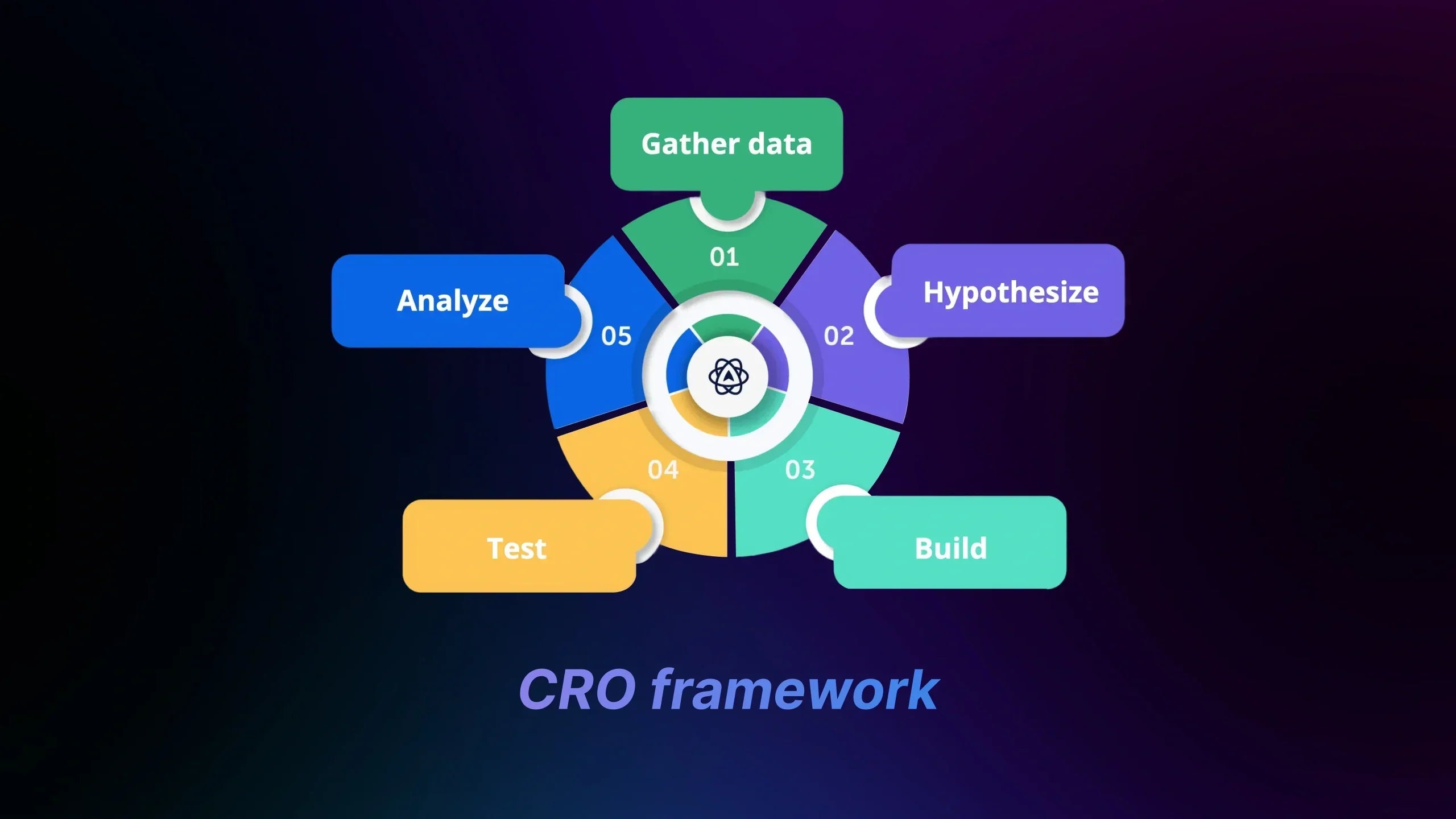
The 5-step CRO framework for winning businesses

With a CRO framework, Shopify merchants have a structured way to transform raw data into measurable growth. Rather than relying on opinions, this ensures every optimization decision is based on evidence, testing, and continuous refinement.
Step 1: Data collection
Before any tests, the CRO framework requires a clear understanding of how users currently behave. Data collection provides marketing data to identify the real friction points that block revenue. There are several data sources that shop owners can employ.
-
Quantitative data
Quantitative data includes traffic sources, conversion rate, and funnel drop-offs. Traffic sources such as paid ads, search engines, email, or social media indicate where visitors come from and explain why audiences convert.
Conversion rates reveal how effectively the store turns traffic into revenue. Funnel drop-offs show where users leave the buying process and help to identify where friction is causing lost sales and where optimization should be prioritized.
-
Behavioral data
Behavioral data, including heatmaps, session recordings, and scroll depth, explains how visitors actually interact with your Shopify store. Heatmaps reveal click, scroll, and stay habits to identify which elements drive engagement or ignorance.
Session recordings show real browsing behavior, including hesitation, confusion, and errors that standard analytics cannot capture. Scroll depth measures how far users move down a page, indicating whether key content, offers, and calls to action are being seen or missed before visitors leave.
-
Qualitative inputs
Qualitative inputs provide context that raw numbers cannot capture. These include surveys that reveal customer confusion, trust issues, or purchase intent, as well as other customer support insights that highlight recurring objections, product concerns, and checkout friction that may not appear in other analytics.
Step 2. Hypotheses formulation
Once meaningful data has been collected, the next step is to convert those insights into structured ideas that can be tested. This stage ensures that hypotheses are based on evidence. Strong hypotheses provide clarity on what will be changed, why it matters, and what result is expected.
#1. Translate data into hypotheses
A hypothesis is a clear statement that links an observed problem to a proposed solution and a measurable outcome. Well-written hypotheses follow a simple cause-and-effect logic to prevent random testing and allow easier evaluation.
For example, if data shows that users abandon the product page before scrolling to key information, a hypothesis might be: If we move product benefits above the fold, then more users will engage and add the item to cart, as they see the value sooner. This structure ensures that every test aims at a defined goal.
#2. Prioritization: RICE score, Value vs. Effort model, and PIE. framework
Not all hypotheses should be tested at once. Prioritization helps teams focus on the ideas most likely to deliver meaningful results.
- RICE Score

The RICE score helps teams decide which experiments are worth running first. It measures how many users a change will affect, how strong the impact could be, how confident the team is, and how much work it takes to build.
It is best used to compare multiple test ideas across different pages or funnels. The model multiplies Reach, Impact, and Confidence score, then divides by Effort score to highlight which changes deliver the greatest return for the least work.
- Value vs. Effort model

The Value vs. Effort model helps identify quick wins versus costly initiatives. It compares how much business value a test might produce against how difficult it is to implement. This model is useful when planning a testing roadmap because it makes it easier to prioritize ideas that drive meaningful gains without slowing down development or marketing teams.
- PIE framework

The P.I.E. framework helps prioritize experiments based on where improvement is needed, where it matters most, and how to test. It looks at Potential, Importance, and Ease to rank opportunities across product pages, collections, and checkout steps. This framework works well for Shopify teams that want a practical way to focus on tests that can move revenue while staying realistic about resources.
#3. Planning and Documentation
Once hypotheses are prioritized, they must be documented before testing begins. Each test should include the hypothesis, target pages, success metrics, and the expected impact. This makes it possible to compare results across experiments. Proper documentation also builds a database over time, as unsuccessful tests can provide valuable insights to help future decisions be more accurate and efficient.
Step 3. Launch Your Experiment
Testing is where ideas become evidence. Once hypotheses are defined and prioritized, controlled experiments are used to validate whether a change truly improves performance. A proper testing process ensures that decisions are based on real customer behavior, not opinions or assumptions.
#1. Types of CRO experiments
Different testing methods serve different optimization goals. Choosing the right one depends on traffic volume, the number of elements being tested, and how results are needed.
|
Test Type |
What it is |
Best used for |
|
A/B testing |
Compares two versions of one page or element to see which performs better |
Test single changes such as a headline, CTA, or product image |
|
Multivariate testing |
Tests multiple elements on a page at the same time |
Test and optimize multiple design elements |
|
Multi-armed bandit testing |
Automatically shifts traffic toward the better-performing variation during the test |
Maximizing revenue during live tests matters |
A/B testing is the most common method for Shopify stores, while multivariate and bandit testing are used when traffic and experimentation maturity are higher.
#2. Common test elements on Shopify stores
Testing should focus on areas that have the greatest impact on revenue and user flow. The most effective experiments typically target:
-
Headlines and hero sections, which shape first impressions and set user expectations during their visit to your landing page.
-
Product page layout and media, including images, videos, and product descriptions
-
Call-to-action wording and placement, such as “Add to Cart” or “Buy Now.”
-
Checkout flow and trust signals, including payment options, review sections, shipping clarity, and security badges
These elements directly influence how confident visitors feel and how easily they can move toward a purchase.
#3. Metrics to track during tests
To evaluate whether a test is successful, both business and behavioral metrics must be measured.
Primary metrics show direct financial impact:
-
Conversion rate: Indicates how many visitors complete a purchase.
-
Revenue per visitor: Reflects conversion performance and order value.
Secondary metrics explain why performance changes:
-
Bounce rate: Signals early exit behavior.
-
Engagement: Metrics such as time on page or scroll depth.
-
Add-to-cart rate: Shows product interest before checkout.
Together, these metrics reveal not only whether a test worked, but also how it changed customer behavior across the buying journey.
Step 4. Results analytics
After running experiments, interpreting the results accurately is critical. This step combines statistical evaluation and behavioral validation to determine whether changes truly improve performance.
#1. Statistical evaluation
-
Confidence level and significance
This tells how sure merchants can be about the estimate, and the results are meaningful. A 95% confidence level (p ≤ 0.05) is the standard threshold. Results between 90% and 95% are directional but not conclusive, while results below 90% should not be used for decision-making.
-
Sample size validation
A test must have a sufficient sample size to ensure generality and validity. In practice, most tests require a sample of several thousand to ensure results are statistically reliable.
#2. Behavioral validation
-
Heatmap and session replay comparison
By comparing click patterns, scroll depth, and cursor movement between the control and variant, merchants can confirm if design or layout changes alter user behavior.
-
Funnel progression changes
Funnel analysis shows whether users move more smoothly through key steps such as product view, add-to-cart, and checkout. A successful test should reduce drop-offs and increase completion rates at the stages targeted by the experiment.
#3. Business impact assessment
-
Revenue uplift
Revenue uplift measures the additional revenue generated by the winning variation. By multiplying the change in conversion rate or revenue per visitor by total traffic, this provides a clear view of the financial impact of the test.
-
Effect on downstream metrics (AOV, retention)
Analysts also review changes in average order value and repeat purchase to ensure the test improves long-term customer value. A variation that increases conversion but lowers order value or retention may not be a win for your business.
Step 5. Repeat and Scale
The CRO framework does not end when a test reaches statistical significance. Each result becomes an input for the next optimization plans. Winning variations should be rolled out, documented, and used as benchmarks for future experiments, while unsuccessful cases provide insights into what does not work.
Scaling means expanding what works across more pages, products, and traffic segments. If a checkout improvement lifts conversion rate, it should be tested on other payment flows or devices.
If a product page layout performs better, it can be applied across similar collections. Over time, this continuous loop of testing, learning, and rollout allows Shopify stores to increase conversion performance in a controlled and predictable way rather than relying on isolated wins.
4 Common Types of CRO Tools You Should Know
#1. A/B Testing and Experimentation Tools
A/B testing tools are the execution engine of a CRO framework. They allow merchants to compare different versions of a page, layout, or element and determine which variation produces better outcomes. These platforms manage traffic, evaluate user experience, identify frictions, and provide data for decisions.

Many platforms, such as GemX, combine A/B testing with multipage analytics, funnel tracking, and journey analysis, making it possible to see not only which version performs better but also how a change influences the full customer journey. This helps merchants evaluate impacts across conversion rate, engagement, and revenue to build a reliable and scalable CRO framework.
#2. Behavior Analytics and Heatmap Tools
Behavior analytics tools reveal how visitors interact with a store before any testing begins. Heatmaps, scroll maps, and movement tracking show where users click, how far they scroll, and which elements engage them.

Platforms such as Hotjar, Microsoft Clarity, and Crazy Egg provide visual evidence of user behavior across product pages, landing pages, and checkout steps. These help merchants decide what to test, for example, whether users miss a CTA, hesitate near pricing, or abandon before reaching key product details.
#3. Session Replay
Session replay tools allow teams to watch real customer sessions to understand how users navigate, hesitate, or abandon. These reveal usability problems such as broken layouts, confusing navigation, or form errors.

Use session replay tools to support your CRO framework
Tools like FullStory, Smartlook, and Mouseflow combine replays with journey and funnel analysis, making it possible to see how users move from landing pages to product pages and to checkout. This supports CRO by validating whether design and content changes improve flow and reduce friction at each stage.
#4. Customer feedback and survey tools
Quantitative and behavioral data show what users do, but feedback tools explain why they do it. On-site surveys, exit polls, and feedback widgets capture user intent, objections, and trust concerns in real time.
Platforms such as Sprig, Hotjar Surveys, and Shopify-integrated feedback tools allow merchants to collect insights about pricing confusion, product expectations, and checkout hesitation. These insights strengthen test hypotheses and help teams avoid misleading assumptions.
Other CRO Tools
A complete CRO framework also relies on other tools to provide context and measurement. Web analytics platforms like Google Analytics 4 track traffic quality and conversion paths. Tag managers such as Google Tag Manager ensure accurate event tracking. Website performance tracker tools like PageSpeed Insights and Lighthouse help connect site speed to conversion outcomes.
Together, these tools create a connected optimization system that supports analysis, experimentation, and continuous improvement across the Shopify store.
CRO Framework Mistakes on Shopify and How to Avoid Theme
However, even a well-designed CRO framework fails if merchants only focus on tactics rather than process. The following mistakes are among the most common reasons Shopify optimization plans stall or produce misleading results.
-
Testing without sufficient traffic
Running experiments without enough visitors leads to unreliable conclusions. When traffic or conversion volume is too low, results are highly sensitive to random variation and increase the chance of incorrect decisions. This often drives merchants to implement changes that seem successful in small samples but fail when rolled out to all users.
-
Optimizing isolated pages instead of funnels
Many Shopify stores focus on individual pages without considering users' behavior across the entire funnel. Conversion depends on how well all steps work together, from landing pages to checkout and post-purchase flow. Improving one page while ignoring other drop-offs can produce little or no revenue.
-
Focusing on vanity metrics
Metrics such as page views, time on site, or click counts can look impressive but often fail to reflect real business performance. These numbers may increase even while revenue, average order value, or completed purchases remain flat. When optimization decisions are based on vanity metrics, teams risk making changes that do not contribute to growth.
-
Ignoring qualitative behavioral data
Without qualitative insights, such as on-site feedback or support tickets, merchants miss the reasons behind drop-offs and hesitation. This often leads to incorrect hypotheses and ineffective tests. Merchants need a framework that integrates behavioral with performance data so experiments target real problems.
Conclusion
A well-structured CRO framework enables your Shopify stores to grow in a scalable way. With this framework, merchants can use data, experimentation, and continuous learning to effectively convert and engage customers. Through data collection, hypothesis formation, testing, and implementation, shop owners can make confident decisions that lead to higher conversion rates, stronger customer experiences, and more sustainable long-term growth.
FAQs about the CRO Framework


