


- What Is Landing Page Testing
- How Landing Page A/B Testing Differs From General CRO
- Types of Landing Page Testing You Should Run
- Why Landing Page A/B Testing Is Critical for Shopify Merchants
- High-Impact Elements to Test on Your Landing Page
- How to Run a Landing Page A/B Test (Step-by-Step)
- 5 Common Mistakes When Running Landing Page A/B Testing
- Conclusion
- FAQs about Landing page A/B Testing
Landing page A/B testing often fails because teams chase surface-level tweaks, like button colors, while ignoring strategy, traffic quality, and statistical rigor. The result is false winners, wasted spending, and “uplifts” that disappear the moment campaigns scale.
Today, let's breaks down how to run landing page A/B tests that actually move conversions, using proven Shopify frameworks grounded in real experiments, CRO benchmarks, and revenue impact.
What Is Landing Page Testing
For Shopify merchants, landing page A/B testing isn’t a “nice to have” anymore, it’s a survival skill. With paid traffic costs rising and organic reach harder to earn, you can’t afford to guess which page version works. You need a structured way to make changes with confidence, not vibes.

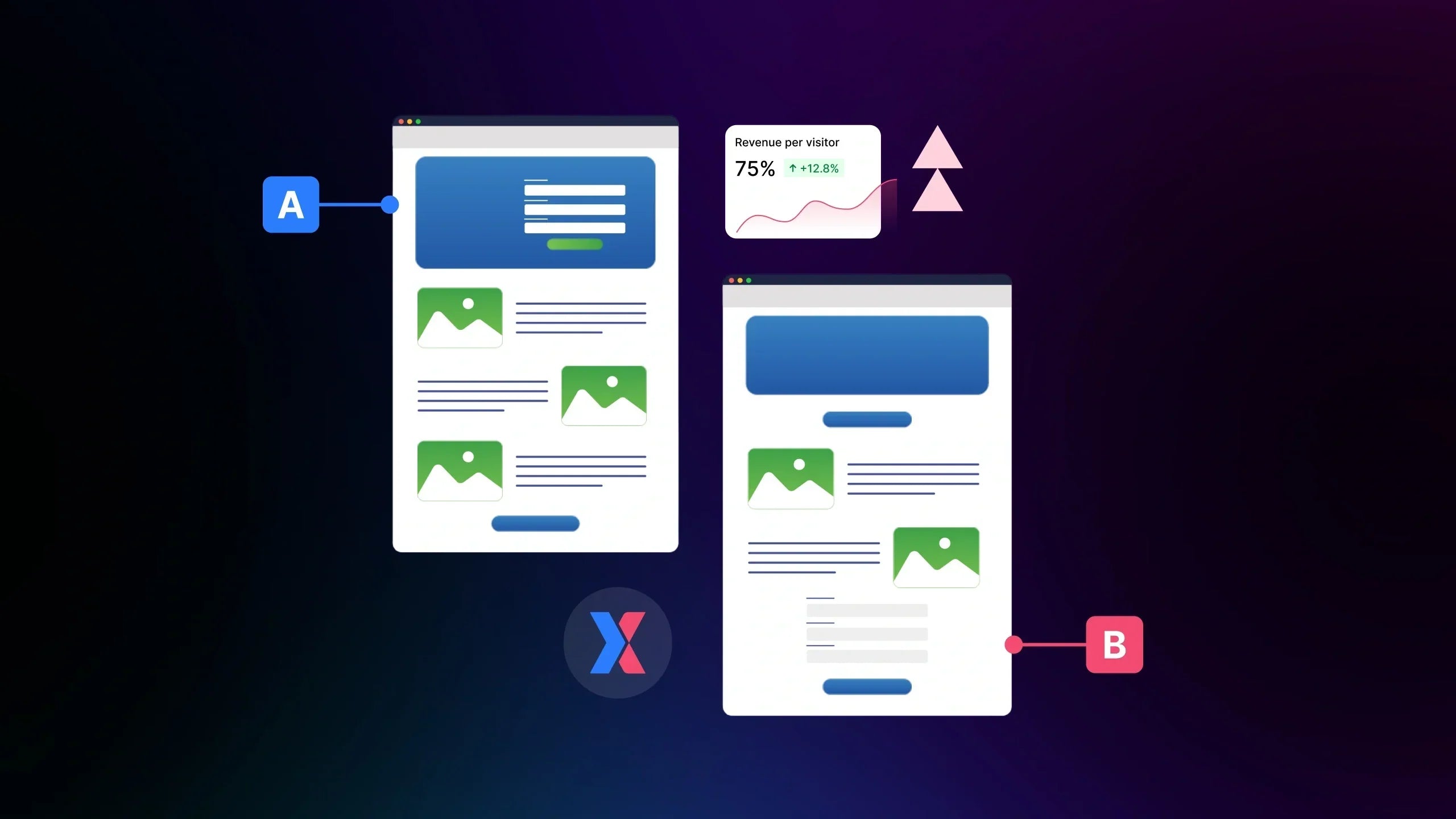
At its core, landing page A/B testing is a controlled experiment where you compare one meaningful change against a baseline page to see which version performs better.
But in real Shopify environments, proper A/B testing must be:
-
Hypothesis-driven: Every test starts with a clear assumption, not a random idea, for example: “If we clarify the value proposition above the fold, paid traffic visitors will convert at a higher rate because message match improves”.
-
Statistically valid: Results must reach sufficient sample size and confidence before declaring a winner (Stopping early is how false winners happen.)
-
Revenue-focused: Conversion rate alone is not enough. Key metrics like revenue per visitor (RPV) often matter more for Shopify stores.
From working with Shopify merchants, a common mistake is “testing” changes in production without a control. That’s not A/B testing, that’s guessing with extra steps.
Learn more: How Dedicated Landing Pages Outperform General Homepages

How Landing Page A/B Testing Differs From General CRO
Landing page A/B testing is a subset of CRO, but it behaves very differently from optimizing blog pages or category listings.
A landing page usually has:
-
Single intent
-
Single conversion goal
-
High dependency on traffic source
That makes it far more sensitive to a few critical factors:
-
Message match: The promise in your ad or email must match the first screen of the landing page. Even small mismatches can tank conversions.
-
Traffic quality: Cold paid traffic reacts very differently than returning or organic visitors. A test that “wins” on organic traffic may fail on Meta ads.
-
Page speed: Landing pages are often built fast and iterated often, performance issues creep in easily.

According to Google, as page load time goes from 1s to 3s, the probability of bounce increases by 32%. This matters more on Shopify because:
-
Many merchants rely heavily on paid traffic
-
Theme-based layouts can add hidden performance debt
-
Apps and scripts often interfere with test accuracy
Learn more: How to Fix Low Conversion Rate on Shopify with A/B Testing
Types of Landing Page Testing You Should Run
Not all landing page tests are created equal, and for Shopify merchants, choosing the wrong testing method is one of the fastest ways to waste traffic, time, and budget. Before running any experiment, it’s critical to understand which type of landing page testing fits your store’s traffic level, risk tolerance, and business goal.
In practice, most failed A/B testing programs don’t fail because of bad ideas—they fail because the testing method itself was a mismatch from the start.
A/B Testing (Single-Variable Testing)
A/B testing is the most common, and most reliable, form of landing page testing for Shopify stores. In an A/B test, you compare a control page against one variation where only a single meaningful element is changed, such as:
-
The main headline
-
Value proposition framing
-
CTA copy or placement
-
Hero image or social proof placement
This method works well because it allows you to clearly attribute performance changes to one cause. From real Shopify experience, A/B testing is especially effective for stores running paid traffic, where traffic volumes are limited and mistakes are expensive.
For most e-commerce merchants, A/B testing should be the default choice because:
-
It requires less traffic to reach statistical significance
-
Results are easier to interpret and explain to stakeholders
-
It minimizes revenue risk during experimentation
If your store is still validating messaging, offers, or funnel structure, A/B testing gives you clean learnings without overcomplicating the process.
Multivariate Testing (High Traffic, High Complexity)
Multivariate testing allows you to test multiple elements at the same time and measure how different combinations perform against each other. While this sounds powerful in theory, it comes with serious practical constraints.

Each additional element you test multiplies the amount of traffic required. For example, testing three headlines and three CTA versions doesn’t create three variations, it creates nine. Most Shopify stores simply do not have enough qualified traffic to support this kind of testing reliably.
From hands-on CRO work, multivariate tests often fail because:
-
Sample sizes never reach validity
-
Results become statistically noisy
-
Teams can’t confidently explain why a variation won
Multivariate testing only makes sense if your store already:
-
Has very high daily traffic
-
Has a stable, proven landing page baseline
-
Is optimizing micro-interactions rather than core messaging
For the majority of Shopify merchants, multivariate testing introduces more confusion than clarity.
Split URL Testing (When You’re Challenging Core Assumptions)
Split URL testing is fundamentally different from A/B testing. Instead of modifying elements on the same page, each version lives on its own URL, and traffic is split between them.
This approach is best suited for big, structural changes, such as:
-
Complete layout redesigns
-
Major pricing or offer changes
-
Long-form vs short-form landing pages
-
Different checkout or funnel logic
Because split URL tests don’t isolate individual elements, they won’t tell you which specific change caused the uplift, but they are extremely useful when you want to test entire concepts against each other.

In some projects, split URL testing is often used when teams want to validate a new direction without risking the original page. It’s especially helpful for high-stakes decisions where incremental A/B testing would take too long.
Important note: Not every store should use advanced testing methods. Using the “most complex” approach doesn’t make your CRO better. It usually makes it less reliable.
Why Landing Page A/B Testing Is Critical for Shopify Merchants
Landing page A/B testing is no longer about incremental optimization, it’s about making paid traffic sustainable. As acquisition costs continue to rise, even small inefficiencies on a landing page can quickly erase margins and stall growth.
The Reality: Traffic Is Expensive
Paid traffic is getting harder and more expensive to scale.
Industry data shows that Facebook (Meta) and Google Ads costs have increased steadily as competition intensifies. For e-commerce stores, this means one thing: you can’t rely on ad optimization alone.
When traffic costs rise, the fastest way to regain efficiency is improving how many visitors convert once they land. Landing page A/B testing gives merchants leverage by increasing performance without increasing spending.
What You Can Improve With Proper Testing
Well-run landing page A/B tests improve more than just conversion rate:
-
Conversion rate (CVR): clearer messaging and stronger offers reduce hesitation
-
Cost per acquisition (CPA): higher CVR lowers effective acquisition costs
-
Revenue per visitor (RPV): pricing clarity, bundles, and value framing matter
-
Funnel drop-offs: tests reveal where paid traffic disengages

In real work, many landing pages don’t fail because of traffic quality. They fail because the page doesn’t answer user questions fast enough.
Realistic Benchmarks (Set Expectations)
A/B testing works best when expectations are grounded in reality. The typical Shopify landing page conversion ranges (directional):
-
Lead-focused pages: ~5–15%
-
Product or launch pages: ~2–5%
-
Collection or pre-sale pages: ~1–3%
Typical uplift from a solid test:
-
5–10%: common and healthy
-
15–30%: strong win, usually messaging-driven
-
50%+: rare, often signals a major mismatch was fixed
From hands-on Shopify testing, the biggest lifts almost always come from message match and value clarity, not cosmetic UI changes.
High-Impact Elements to Test on Your Landing Page
Not all landing page elements deserve the same level of attention. In reality, the goal of landing page A/B testing is not to test everything. It’s to focus on the elements that most directly influence how users understand your offer, evaluate risk, and decide whether to convert.
#1. Above-the-Fold Messaging (Highest ROI)
If visitors don’t immediately understand your value within the first few seconds, no amount of optimization further down the page will save the conversion. This is why above-the-fold messaging is often the highest-ROI testing area for Shopify landing pages.

Headline clarity vs. Cleverness
High-performing Shopify landing pages consistently prioritize clarity over creativity. While clever headlines may look polished or “on brand,” they often underperform because they force users to think.
Effective headlines clearly answer three questions:
-
What is this?
-
Who is it for?
-
Why should I care?
For cold traffic especially, clever wordplay increases cognitive load and slows decision-making. Research from Nielsen Norman Group shows that users scan rather than read, and clarity plays a critical role in whether they continue engaging with a page.
Subheadline as a friction reducer
The role of the subheadline is not to repeat the headline, it’s to reduce doubt. Strong subheadlines typically:
-
Add specificity around use case or outcome
-
Address a common objection early
-
Reinforce credibility or differentiation
In Shopify A/B tests, subheadlines that explain the mechanism, how the product actually helps, often outperform vague benefit statements that sound good but say very little.
Message match with ads or email traffic
Message mismatch is one of the most common and costly conversion killers. For example, when a Meta ad promises “Free Shipping in 48 Hours” but the landing page opens with abstract brand storytelling, users hesitate or bounce.
From hands-on Shopify testing, fixing message match alone, often produces double-digit conversion lifts, even without changing layout, visuals, or CTAs.
#2. Value Proposition & Offer Framing
Once users understand what you offer, the next question becomes far more important: why choose you? This is where value proposition and offer framing tests have a major impact.

Feature-led vs. outcome-led framing
Features describe what a product does. Outcomes describe what users get. For example:
-
Feature-led: “Built with premium materials”
-
Outcome-led: “Built to last 3× longer than standard options”
Across Shopify A/B tests, outcome-led framing tends to perform better for cold traffic, while feature-led framing can work for returning or more informed users. Testing this distinction helps align your messaging with visitor intent.
Risk reversal (free shipping, returns, trials)
Reducing perceived risk often has more impact than adding new benefits. Baymard Institute research shows that unclear or restrictive return policies are a major cause of cart abandonment
Testing variations such as:
-
“Free returns, no questions asked”
-
“30-day risk-free trial”
-
“Free shipping over $X”
can significantly improve conversions without touching price or product positioning.
Incentive timing (Immediate vs. Delayed)
A common mistake is focusing only on what incentive to offer, instead of when to show it. In practice:
-
Immediate incentives work better for cold, price-sensitive traffic
-
Delayed incentives (such as exit intent offers) help preserve margin while capturing hesitant users
Testing incentive timing often delivers more insight and better results than testing incentive value alone.
#3. CTAs That Actually Move Users
CTAs rarely fail because of color choices. They fail because they don’t clearly communicate what happens next.

Copy: Action-oriented vs. Benefit-oriented
High-performing CTA copy is specific and expectation-setting. You can compare:
-
“Get Started”
-
“Start Free 14-Day Trial”
-
“See How It Works in 2 Minutes”
Clear CTAs reduce anxiety and improve click-through quality, not just raw clicks, an important distinction for Shopify funnels.
Placement: First fold, Mid-page, and Sticky CTAs
Effective landing pages rarely rely on a single CTA. Based on Shopify testing patterns:
-
A primary CTA should appear above the fold
-
Secondary CTAs should follow key persuasion sections
-
Sticky CTAs work best when they don’t interrupt reading flow
Each placement should support the user’s decision journey, not rush it.
Visual contrast through hierarchy, not just color
Contrast isn’t just about button color, it’s about visual priority. Effective CTAs typically:
-
Have sufficient whitespace around them
-
Stand out clearly from surrounding elements
-
Avoid competing with secondary actions
These hierarchy-based tests often outperform simple color swaps.
#4. Social Proof & Trust Signals
For unfamiliar Shopify brands, trust is often the deciding factor.

Reviews, testimonials, and logos serve different roles
Each type of social proof supports a different stage of decision-making:
-
Reviews provide validation at scale
-
Testimonials offer emotional reassurance
-
Logos establish authority and legitimacy
According to BrightLocal, 89% of consumers read online reviews before making a purchase.
Quantity vs. Relevance
More reviews aren’t always better. Relevant reviews convert better. Shopify testing consistently shows that:
-
A few highly relevant testimonials outperform large generic blocks
-
Reviews that mirror the visitor’s use case build trust faster
Placement near Decision Points
Random placement reduces impact. Social proof performs best when placed:
-
Near the CTAs
-
Around pricing sections
-
Before forms or checkout steps
This aligns trust with moments of hesitation.
#5. Forms, Checkout, and Friction Points
Every additional step or input field increases the chance of abandonment.
Single-step vs. Multi-step flows
Multi-step forms can outperform single-step forms if they feel easier psychologically. Baymard UX research confirms that overly long or complex checkout processes significantly increase abandonment.
Field reduction tests
Field reduction remains one of the highest-impact landing page tests. Effective experiments include:
-
Removing non-essential fields
-
Clearly marking optional fields
-
Delaying data collection until after conversion
Even removing a single unnecessary field can noticeably improve completion rates.
Microcopy near inputs
Small reassurance text near form fields reduces anxiety:
-
“We’ll never share your email”
-
“Cancel anytime”
-
“No credit card required”
These microcopy tests often deliver outsized impact relative to effort.
High-Impact Landing Page Test Matrix (Recommended)
To improve scannability and decision-making, this section works well with a table such as:
|
Element Tested |
Primary Metric |
Typical Impact |
Risk Level |
|
Headline |
Conversion Rate |
High |
Low |
|
Value Proposition |
CVR / RPV |
High |
Medium |
|
CTA Copy |
CTR to CVR |
Medium |
Low |
|
Social Proof |
CVR |
Medium |
Low |
|
Form Fields |
Completion Rate |
High |
Medium |
How to Run a Landing Page A/B Test (Step-by-Step)
Most team tests don’t fail because the idea was bad, they fail because the process was weak. This framework is designed for real-world Shopify conditions: mixed traffic quality, limited volume, and pressure to show revenue impact fast. Follow these steps to run tests that produce learnings you can actually trust, and scale.
Step 1: Diagnose Before You Test
Before changing anything, you need to understand where users struggle, not what you think they dislike. Strong A/B tests start with diagnosis, not brainstorming.
Use a mix of quantitative and qualitative signals:
-
GA4 to identify drop-off points, device splits, and traffic-source performance
-
Heatmaps and session replays to see where attention stalls or friction appears
-
On-page surveys to capture intent and hesitation in the moment
The goal here is to find behavioral friction, not opinions. For example, if replays show users repeatedly hovering over shipping info, the issue isn’t “design”—it’s uncertainty. That’s a testable problem.
This is where GemX add real leverage. By layering targeted, non-intrusive surveys on key moments (e.g., exit intent or after scrolling past the hero), you can capture why users hesitate, then tie those insights directly to test ideas instead of guessing.
Pro tip: Pages with “good” engagement metrics can still hide serious friction. Diagnosis should always precede ideation.
Step 2: Build a Testable Hypothesis
A/B testing without a hypothesis is just structured randomness. A good hypothesis connects from user insight to change and metric in a way that can be proven wrong.
Use this simple formula:
If we change X for audience Y, then metric Z will improve because…
For example:
-
Weak hypothesis is “Changing the CTA color will increase conversions.”
-
Strong hypothesis is “If we clarify the value proposition above the fold for paid traffic users, conversion rate will increase because the current headline doesn’t match ad intent.”
The difference matters as strong hypotheses:
-
Are based on observed behavior (not preferences)
-
Focus on a single cause-and-effect relationship
-
Define success clearly before the test runs
In practice, Shopify teams that document hypotheses build a testing knowledge base that compounds over time instead of repeating the same ideas.
Step 3: Choose the Right Metric (Not Just Conversion Rate)
Conversion rate is important, but it’s not always the right primary metric, especially for Shopify stores.
Choose metrics based on what the test is actually trying to influence:
-
CVR: Clarity, trust, or friction-reduction tests
-
Revenue per visitor (RPV): Pricing, bundles, or offer framing
-
Add-to-cart rate: For PDP or pre-checkout elements tests
-
Scroll depth or engagement: Only use as supporting signals, never final success criteria

A common mistake is declaring a test “won” because clicks increased while revenue stayed flat or dropped. Metrics should reflect business impact, not surface engagement.
Step 4: Run the Test Correctly
Execution quality determines whether your results are meaningful or misleading.
Start with clean traffic allocation. Most A/B tests should split traffic evenly unless you’re running a risk-managed experiment on a high-revenue page.
Next, respect test duration. Ending tests early, especially after a few good days, is one of the most common causes of false winners. According to CXL, premature stopping dramatically increases false positives in experimentation.
Also account for:
-
Novelty effects, where new designs temporarily outperform
-
Device segmentation, since mobile and desktop behavior often diverge
-
Consistency, ensuring no other major site or campaign changes interfere
GemX helps here by monitoring test stability and ensuring traffic segmentation stays consistent across devices and sources. It’s critical for Shopify stores running multiple campaigns at once.
Step 5: Analyze & Decide Like a Pro
When the test ends, resist the urge to default to whatever shows green.
Statistical significance, in simple terms, only answers one question: Is this result likely real, or could it be random? Most teams aim for 95% confidence as a baseline, but confidence alone isn’t enough.

Ask three questions before deciding:
-
Is the result statistically reliable?
-
Does it improve a business metric that matters?
-
Does the outcome align with what we observed about user behavior?
Based on those answers, you have three valid actions:
-
Ship the winner if results are clear and meaningful
-
Iterate if the direction is right but impact is limited
-
Kill the idea if the hypothesis was wrong—and document the learning
Experienced Shopify teams know that “losing” tests are often more valuable than wins, because they prevent future mistakes.
Important note: Results vary based on traffic quality, seasonality, and offer maturity. A/B testing reduces risk, it doesn’t eliminate it.
Learn more: 6 Practical Tips to Read and Act on A/B Testing Results (From Winning Stores)
5 Common Mistakes When Running Landing Page A/B Testing
Even experienced teams still make testing mistakes, not because they lack ideas, but because they underestimate how fragile test validity can be. These are the errors that most often lead to false winners and wasted scale.
1. Testing Too Many Things at Once
Changing multiple elements in a single test may show a performance shift, but it rarely produces a clear insight. When headline, CTA, layout, and visuals change together, you can’t tell what actually caused the result.
For most Shopify stores, single-variable A/B tests are more reliable because they:
-
Require less traffic
-
Produce clearer learnings
-
Are easier to apply across other pages
Multivariate testing only makes sense for very high-traffic stores optimizing small details on proven pages.
2. Declaring Winners Too Early
Early performance spikes are often misleading. Tests that are stopped before reaching sufficient sample size are vulnerable to randomness, novelty effects, and short-term traffic shifts, especially around weekends.
The fix is simple: let tests run long enough to stabilize, even when early results look good.
3. Ignoring Traffic Source Context
Not all traffic behaves the same. Paid traffic, organic visitors, and email subscribers arrive with different intent levels. A variation that works for one source may underperform or even hurt another. At minimum, results should be segmented by traffic source before decisions are made.
4. Optimizing for Clicks Instead of Revenue
Clicks are easy to optimize, but revenue is not. On Shopify, a CTA that increases clicks but lowers purchase quality can hurt overall performance. That’s why metrics like revenue per visitor (RPV) are often more reliable than conversion rate alone.
Conclusion
Landing page optimization is no longer about guessing what looks good. It’s about making informed decisions that protect your margins and help your store scale with confidence. By focusing on the right elements, running disciplined experiments, and interpreting results through a business lens, you turn testing into a repeatable growth system rather than a series of one-off tweaks.
If you want to go deeper, exploring GemX resources on experimentation strategy and CRO measurement can help you apply these principles more consistently across your store.
FAQs about Landing page A/B Testing


