


- Overview of A/B Testing Ideas for Shopify
- Why A/B Tests on Shopify Must Follow the Revenue Funnel
- Best A/B Testing Ideas Across Revenue Funnel
- Practical A/B Testing Ideas that Align with Shopify Store Maturity
- Low-Impact Experiments You Should Not Run on Shopify
- How to Prioritize A/B Testing Ideas on Shopify
- Tools That Support High-Impact A/B Testing on Shopify
- Conclusion
- FAQs
A/B testing is not about changing button colors or rearranging pixels. It involves testing decisions that directly influence how shoppers perceive value, reduce risk, and commit to purchase. When executed correctly, experiments help merchants convert traffic into measurable revenue growth without relying on higher ad spend or vain engagement metrics.
But how to select A/B testing ideas that work for Shopify remains a big question for even high-converting businesses. In this guide, merchants can learn which A/B testing ideas actually work on Shopify and how to prioritize ideas based on funnel leverage, store maturity, and business impact.

Overview of A/B Testing Ideas for Shopify
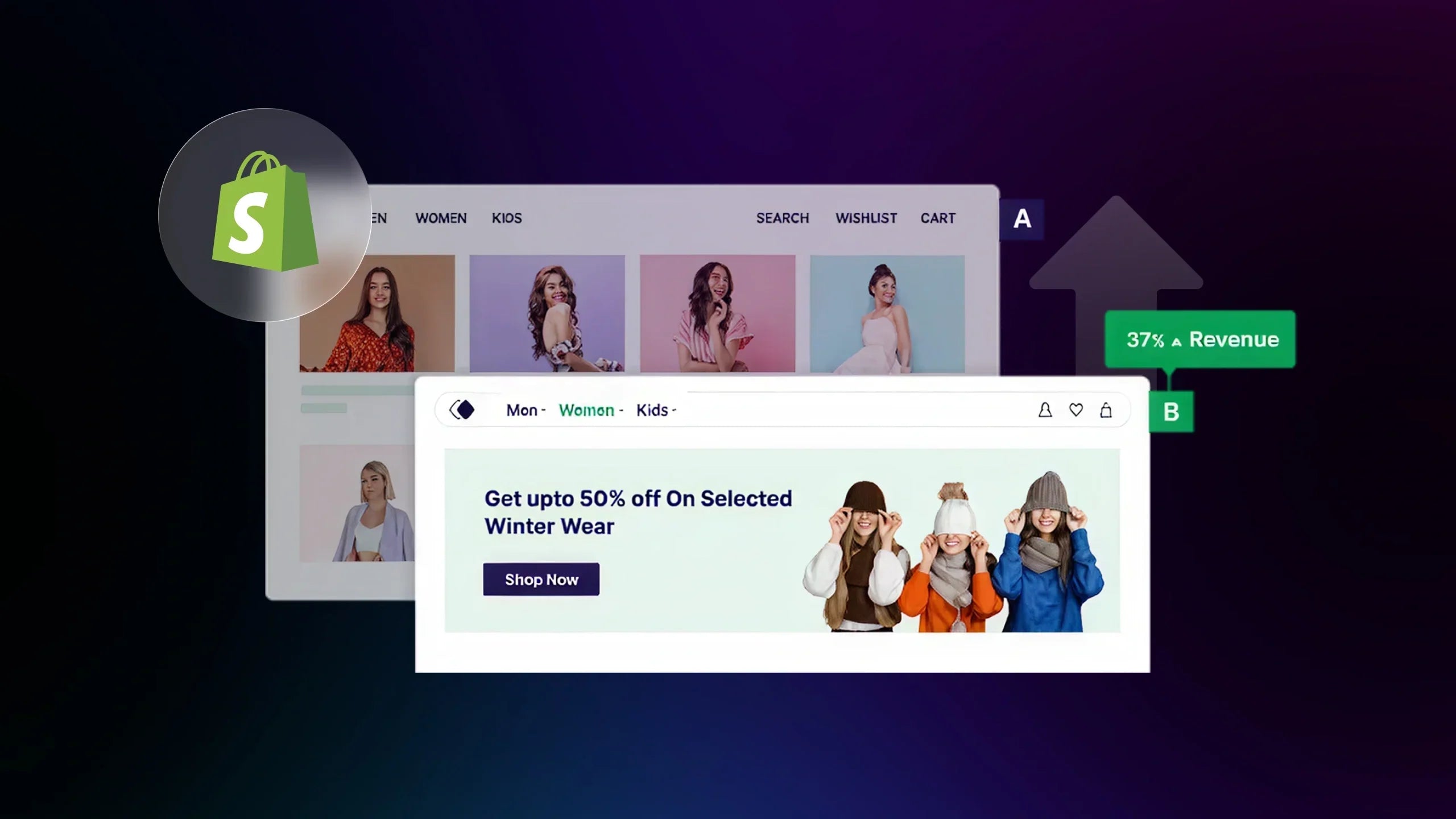
For Shopify stores, effective A/B testing ideas help to encourage buyer purchase decisions. Shopify’s conversion path is relatively standardized, but how value, trust, and pricing are communicated varies widely across stores.
An A/B testing idea “works” when it produces sustained improvement in revenue-related outcomes, such as conversion rate, revenue per visitor, or average order value. This requires aligning experiments with the customers’ evaluation process and decision-making.
Good testing ideas also respect Shopify’s operational reality. Traffic levels, checkout constraints, theme architecture, and app dependencies all influence the test credibility. Winning ideas are those compatible with Shopify while targeting the right audience and supporting other funnel activities.
Learn more: How to Run A/B Tests on Your Shopify Store? Best Tips from Winning Business
Why A/B Tests on Shopify Must Follow the Revenue Funnel
Stores fail because they ignore small frictions across the funnel. A/B testing ideas that ignore funnel position often drive misleading wins that do not drive revenue. High-impact testing follows the revenue funnel as each stage carries a different level of leverage. For example, product pages influence add-to-cart decisions, while carts influence order commitment.

By aligning testing ideas with funnel stages, merchants can focus experimentation on where behavioral change produces the largest revenue impact, rather than optimizing isolated metrics that produce little business outcome.
Best A/B Testing Ideas Across Revenue Funnel
1. Product Page Optimization
Product pages are where shoppers move from interest to intent. On this page, users decide whether the product is relevant, worth the price, and safe to buy. Small changes often create disproportionate revenue impact because they directly influence add-to-cart behavior and price acceptance.

What to test
-
Hero section: product-centric vs context-driven storytelling
-
Value proposition hierarchy and message compression
-
Price perception, engineering, and discount framing
-
CTA: copy, urgency, and friction control
-
Social proof: placement logic and credibility stacking
Why this test matters
Most stores lose revenue because the product page fails to resolve uncertainty. A/B testing helps identify which messages reduce hesitation, which price cues increase acceptance, or which designs guide users toward action. Improvements in product pages often outperform traffic or awareness experiments.
Learn more: Shopify Product Page A/B Testing: A Practical Guide to Higher Conversions
Cart Optimization
At this stage, customers reassess the total cost, delivery expectations, and perceived risk. Cart friction is one of the most common causes of abandoned sessions on Shopify stores.

What to test
-
Cart drawer vs dedicated cart experience
-
Free shipping thresholds as behavioral nudges
-
Trust reinforcement and delivery certainty messaging
-
In-cart upsell logic
Why this test matters
Cart optimization influences whether intent converts into action. Poorly designed carts introduce doubt in the purchase decision. A/B testing allows merchants to understand how layout, incentives, and reassurance affect completion rates and order value. Effective cart tests often increase revenue without changing product pricing or traffic volume.
Checkout Optimization
Checkout is the final barrier between intent and revenue. Checkout performance is highly sensitive to trust, speed, and alignment with payment preferences. Even minor uncertainty at this stage can cause disproportionate drop-offs.

What to test
-
Checkout and payment methods
-
Risk-reversal copy and reassurance mechanisms
-
Discount code field visibility
Why this test matters
Checkout optimization matters because this is where revenue can be lost. Many stores assume checkout optimization is limited, but testing copy, payment methods, and reassurance messaging can significantly reduce abandonment. They protect revenue, making them one of the highest ROI experiments.
Homepage Optimization
The homepage is a traffic router, not a conversion endpoint. Its role is to orient visitors, clarify value, and guide users toward relevant product paths based on intent.

What to test
-
Product-led vs collection-led homepage structures
-
Returning visitor recognition and personalization signals
Why this test matters
Homepage testing determines whether visitors quickly understand what the store offers and where to go next. Without clarity, traffic disperses inefficiently across the site. A/B testing homepage structure and messaging improves funnel entry quality, increases downstream engagement, and ensures paid and organic traffic is converted into meaningful shopping behavior.
Learn more: Test what matters: The Perfect Route to Effective Website A/B Testing
Practical A/B Testing Ideas that Align with Shopify Store Maturity
Not all A/B testing ideas are effective at every stage of a store’s growth. Aligning experiments with store maturity ensures testing effort translates into real business outcomes rather than short-term wins.

For Early-Stage Stores
Early-stage stores often struggle with clarity, trust, and conversion friction. Traffic is often limited, so experiments must focus on removing fundamental blockers rather than optimizing edge cases. There are a few points that their experimentation and optimization efforts must concentrate on:
1. Message Clarity and Offer Articulation tests
These tests focus on whether visitors understand what the store sells, who it is for, and why it is worth buying. Early-stage stores often lose conversions because value propositions are vague or buried. Testing headline clarity, benefit framing, and offer positioning helps ensure users grasp the product’s relevance.
2. Trust Acceleration through Social Proof
New stores lack brand recognition, making trust a primary barrier. A/B testing helps identify how reassurance encourages first-time buyers. This includes testing reviews, testimonials, guarantees, and other indicators to reduce perceived risk.
3. First-purchase Friction Removal
Optimization should prioritize making first purchases feel effortless. Tests examine shipping transparency, return clarity, checkout simplicity, and payment options. Removing uncertainty at this stage often produces the highest conversion lift for new stores.
For new merchants, it is important to build a clear and systematic roadmap to guide their experimentation and optimization efforts. This helps to effectively allocate resources, maximize the power of experiments, and set up a continuous learning system for sustainable growth.
For Scaling and High-Growth Stores
High-growth Shopify stores usually have validated demand and steady traffic. At this stage, A/B testing shifts from proving viability to maximizing revenue efficiency and lifetime value.
4. Pricing architecture and bundle experimentation
As traffic increases, small improvements in price or offer presentation can drive significant revenue impacts. Testing bundles, tiered pricing, subscription framing, and anchor pricing help optimize how value is perceived.
5. PDP information hierarchy optimization
Scaling stores accumulate content over time, which can lead to cluttered product pages. Testing the order and relevance of information helps ensure content aligns with the visitor's intention. These experiments focus on decision efficiency rather than persuasion volume.
6. Cross-sell, upsell, and post-purchase leverage
With a growing customer base, incremental revenue per order becomes a major growth lever. A/B testing post-add-to-cart offers, in-checkout upsells, and post-purchase recommendations helps increase average order value without increasing acquisition costs.
For growing businesses, the goal is to optimize their testing systems to further facilitate marketing, sales, and other operational efforts.
Low-Impact Experiments You Should Not Run on Shopify
Not all A/B tests are worth running. Many experiments consume time and traffic without producing a sustainable revenue impact. Therefore, merchants need careful planning to utilize experimentation and avoid experiments with little business impact.

1. Cosmetic-Only Experiments That Lack Behavioral Intent
Tests that adjust colors, fonts, or spacing often produce short-term changes but rarely influence purchase behavior. These wins may appear statistically significant, but fail to translate into meaningful revenue gains. When visuals exist without clear intent, they tend to generate noise rather than insight.
2. Experiments Run Below Viable Traffic and Sample Size Thresholds
Underpowered experiments create false confidence. Many stores declare winners based on small datasets, hence risking mistaking randomness for improvement. Minimum traffic thresholds matter because reliable conclusions require enough data to separate signal from noise. Without adequate volume, even statistically “significant” results can be misleading.
3. Experiments Measured by Uplift Without Commercial Relevance
Optimizing the wrong metric is one of the most costly mistakes in experimentation. Tests that prioritize clicks, engagement, or micro-conversions can show positive uplift while harming revenue.
For example, increasing clicks to checkout does not guarantee completed purchases or profitable orders. Statistical significance does not equal business success. Stores must reframe success metrics around revenue per visitor, average order value, and long-term profitability to ensure experiments deliver real commercial value.
Learn more: 13+ Costly A/B Testing Mistakes That Hurt Your Conversions (And How to Fix Them)
How to Prioritize A/B Testing Ideas on Shopify
There can be hundreds of great testing ideas, but only a few A/B testing ideas that work to produce meaningful revenue impact. Prioritization is not about testing more ideas, but about testing the right ideas at the right moment. A disciplined prioritization framework ensures experiments target real commercial leakage instead of cosmetic improvements.
Step 1: Identify Revenue Leakage Across the Shopify Funnel
Prioritization begins by understanding where revenue is being lost. Revenue leakage should be analyzed by page type, as product pages, carts, checkout, and the homepage each serve different decision roles.
For example, a drop in add-to-cart rate points to product page friction, while checkout abandonment often signals trust or payment issues rather than pricing problems.

Mapping user drop-off by page type helps isolate which decisions users are struggling to make. This ensures test ideas target customer decisions rather than symptoms such as low engagement or short session duration.
Pro tip: Use GemX: CRO & A/B Testing app for Shopify to identify frictions across the customer journey through journey analysis. From which, you have a clear view of how users interact with a page, and how they move through your store funnel.
Learn more: Funnel Tracking Setup: How to Measure and Optimize Every Step of the Buying Journey
Step 2: Rank Test Ideas by Commercial Impact and Feasibility
Once fictions are identified, ideas should be ranked based on how much revenue they can realistically influence and how feasible they are to test in a Shopify environment.
Commercial impact is determined by three factors
-
The volume of users affected
-
The proximity to purchase
- The size of the behavioral change required.
Tests closer to checkout usually have a higher impact as small improvements affect order completion directly.

Feasibility matters because Shopify stores operate within theme, app, and development constraints. Tests that require minimal effort and low risk to store stability should be prioritized over complex implementations. This prevents teams from chasing ideas that never scale while ignoring simple tests that drive impacts.
Step 3: Validate Traffic and Sample Size Assumptions
Even high-impact ideas fail when traffic is insufficient to support reliable conclusions. Merchants often underestimate the importance of data in experiment result validation. Before launching any test, traffic must be validated based on the primary metric and effect size. Testing with inadequate volume increases the likelihood of false winners, where random variation is mistaken for improvement.
For example, when running template A/B testing, it is important to decide traffic allocation for both versions to gain valid test results.

Avoiding premature conclusions protects long-term performance. Declaring winners too early often leads to rolling out changes that hurt revenue once rolled out. Sample size validation ensures that confidence is earned, not assumed.
Step 4: Define Success Metrics Before Launch
Clear success metrics anchor prioritization and prevent post-test rationalization. Metrics must be defined before launch to avoid bias and shifting goalposts once results appear. For most stores, metrics should align with revenue outcomes rather than engagement.
For example, conversion rate, revenue per visitor, and average order value are typically more meaningful than clicks or scroll depth.
Defining KPIs upfront ensures every test has a clear pass-fail condition. This prevents merchants from celebrating marginal gains that do not contribute to sustainable revenue growth.
Tools That Support High-Impact A/B Testing on Shopify
While strategy determines whether an experiment delivers revenue impact, the right tooling ensures tests are executed cleanly and measured accurately. For new stores, tools should reduce technical friction, integrate with the Shopify ecosystem, and support revenue-focused measurement rather than surface-level engagement metrics.
A/B Testing Tools
Shopify-native A/B Testing tools turn your testing ideas into real experiments that work by controlling variants, traffic allocation, and data integrity across Shopify storefronts.

Shopify-focused tools like GemX enable merchants to test high-impact elements like pricing, product messaging, and funnel structure without heavy engineering effort. Merchants should select a platform that integrates with Shopify’s theme and checkout architecture, minimizes performance overhead, and supports analytics and experiments.
Learn more: Top 5+ Best A/B Testing Tools for Shopify
Analytics & Measurement Stack
Accurate measurement is essential for validating A/B testing ideas. Google Analytics provides broad behavioral visibility across sessions, traffic sources, and user paths, while Shopify Analytics offers native insights into sales, conversion rates, and product performance within the platform.
You can also use server-side event tracking tools to enable more reliable data capture across checkout, payments, and post-purchase events. When combined with experimentation platforms, this ensures tests are evaluated on revenue contribution, funnel progression, and long-term business impact rather than short-term metric fluctuations.
Conclusion
Successful Shopify optimization is not about running more experiments, but about running A/B testing ideas that work. High-impact testing focuses on revenue decisions, prioritizes meaningful behavioral change, and relies on disciplined measurement rather than surface-level engagement. When strategy, prioritization, and tools are aligned, A/B testing becomes a repeatable growth engine rather than a series of isolated experiments.
FAQs


