


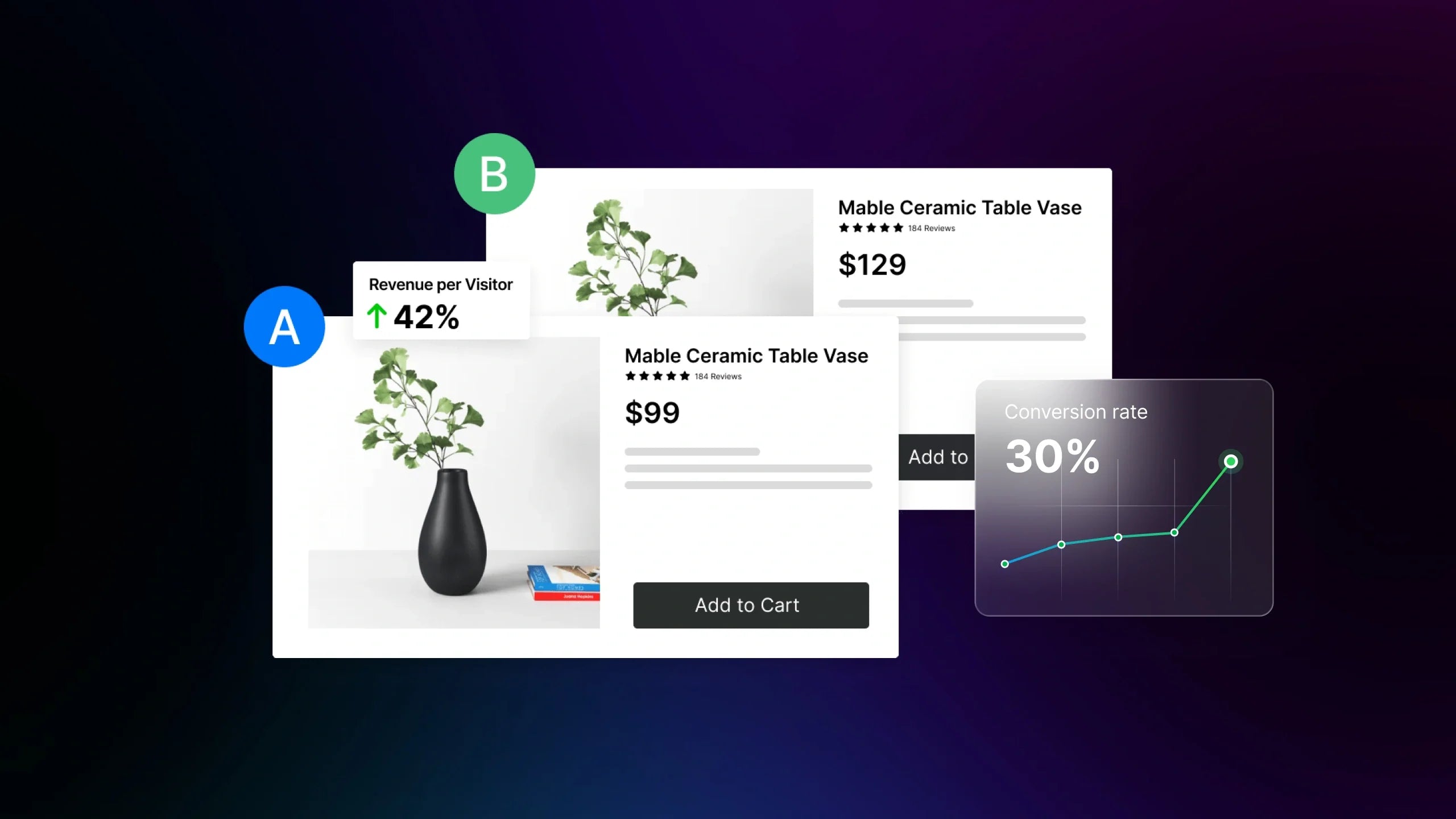
Website A/B testing is one of the most reliable ways to turn traffic into measurable growth. When optimization is driven by controlled experiments, performance improvements become repeatable, predictable, and revenue-oriented.
But merchants can waste resources on testing changes that do not have any significant business impact. It is important to define what to test and how to test.
What is Website A/B testing?
Website A/B testing is a method of comparing two or more versions of a webpage or element to determine which performs better. Shop owners create two versions: one is the control, and the other is the variant.

The testing components can include headlines, page layouts, pricing displays, buttons, or trust elements. Visitors are distributed between variations, and their behavior is measured using metrics such as conversion rate, time on page, or engagement.
The goal of A/B testing is to determine if specific changes genuinely improve business results. What makes website A/B testing powerful is that it isolates cause and effect. Rather than opinions or trends, merchants can see real user interaction to changes. This makes growth scalable rather than unpredictable.

Why A/B Testing Matters for Your Website
Website A/B testing matters because traffic is expensive and user attention is limited. When visitors land on a page, every second and every visual detail shapes their decision to stay or leave. A/B testing ensures that each of those decisions is optimized for business impact.
-
Identify bottlenecks to improve traffic and credibility
A/B testing reveals where visitors hesitate and abandon pages. By testing elements such as navigation, product information, and trust signals, merchants can identify and remove friction that disengages users, thereby significantly boosting engagement and conversion.
-
Boost conversion and reduce bounce rate
Small changes in headlines, calls to action, or page structure can have a significant impact on whether users continue browsing or leave immediately. A/B testing identifies which version keeps visitors engaged and leads them toward conversion, helping reduce bounce rate while increasing completed actions such as sign-ups or purchases.
-
Improve user experience and customer engagement
Better user experiences are not based on opinion but on how real visitors behave. Website A/B testing evaluates how users interact with content, layouts, and flows, making it possible to design pages that feel intuitive, clear, and aligned with user intent. This leads to longer sessions, deeper browsing, and stronger brand trust.
-
Ensure long-term growth and scalability
Because markets and customer expectations constantly change, optimization must be ongoing. A/B testing creates a structured system for learning and improvement, allowing businesses to refine their websites over time and scale growth without relying on increasing ad spend alone.
Key Elements You Should Run for Website A/B Testing
Effective website A/B testing focuses on the elements that have the greatest influence on user behavior and conversion decisions. These elements shape customer experience, engagement, and purchase behaviors. Through systematic testing, merchants can determine which website versions ensure clarity, reduce friction, and have a significant business impact.
1. Headlines and Hero Messaging
Why is it important
Headlines and hero messaging are the main text elements that communicate a page’s purpose, often located at the top of landing pages and product pages. These messages shape how visitors interpret the page within seconds. If the message is unclear or generic, users may leave before exploring further.
What to test
Website A/B testing for headlines and hero messaging should focus on:
-
Value-focused vs feature-focused language
-
Short direct headlines vs longer explanatory ones
-
Emotional appeal vs functional benefit
-
Messaging alignment with traffic sources
Good examples
An effective hero message explains the benefits of the product to customers. For example, “Our vitamin serum reduces dark spots in four weeks” is a strong message as it is clear about the benefit and time frame.

A weak hero message might say, “Discover our premium skincare line.” This does not explain what problem the product solves or why it is different. To improve this, the message should be rewritten to reflect a desirable outcome, such as clearer skin, faster results, or fewer breakouts.
2. Pricing Presentation and Promotional Messaging
Why is it important
Pricing presentation and promotional messaging include how prices, discounts, bundles, and special offers are displayed across the site. Price perception strongly influences buying decisions. The same price can appear expensive or reasonable depending on how it is framed.
What to test
When applying A/B testing, the pricing components that may deserve attention are:
-
Showing full price versus discounted price
-
Bundle offers versus single products
-
Monthly versus one-time pricing
-
Free shipping thresholds
-
Urgency or scarcity messaging
Good examples
A strong pricing layout shows value in context. For example, “From $49/month. Free trial available” reduces risk and sets expectations. Customers can quickly understand what they pay and what they get.
A weak pricing presentation may show only “$39” without explaining what is included or whether shipping is extra. This creates uncertainty and leads to hesitation. The solution is to add supporting information that clarifies the total cost and customer benefits.
3. Calls-to-Action and Button Design
Why is it important
Calls-to-action are the buttons or links that prompt users to take action, such as “Sign up for free” or “Trial for free.” These elements turn interest into action. If these are hidden or unclear, conversions drop even when the page content is relevant.
What to test
-
Button text and tone
-
Size, contrast, or colours
-
Placement on the page
-
One primary CTA vs multiple CTAs
Good examples

A strong CTA uses clear and strong action language. For example, the phrase “Start your free trial” clearly states the benefits to attract customers, thereby reducing fear and encouraging conversion.
A weak CTA, such as “Submit” or “Continue” is vague and does not explain the outcome. This creates friction. Replacing it with a benefit-oriented phrase like “See plans” or “Add to cart” makes the action clearer and more persuasive.
4. Popups and Banners
Why is it important
Pop-ups and banners are used to present offers, collect emails, or provide information. As these elements influence whether visitors stay or leave, they must add value without disrupting the experience.
What to test
Some customers might feel uncomfortable when their browsing is abrupt by sudden and excessive pop-ups or displeasing banners. Shop owners need to use website A/B testing to ensure that what they add to their pages never interrupts or disengages their visitors:
-
Timing, such as immediate vs exit intent
-
Offer type, such as discount vs free shipping
-
Message tone and clarity
-
Display rules by device
Good examples

A useful pop-up might say “Get 10% off your first order when you join our email list.” This works because it gives visitors a clear incentive in exchange for their email. This also appears when the visitors first enter the page and avoids showing up again when they scroll to another content.
A harmful pop-up appears immediately and blocks the page with no clear benefit. This interrupts users before they even see the content. A bad pop-up appears too many times, especially when visitors click on any on-page content or elements. These might significantly frustrate the visitors and give them a negative impression of the page and your store.
5. Social Proof Elements
Why is it important
Social proof elements are signals that show other people have already trusted and purchased from your business. These include customer reviews, star ratings, trust badges, security icons, testimonials, user photos, and media mentions.
As most visitors arrive with doubt, social proof reduces perceived risk and increases perceived legitimacy. When strong proof is present, visitors feel reassured that the product works, the company is real, and the purchase is safe. But when social proof is weak, hidden, or poorly placed, visitors hesitate and leave. That directly increases bounce rate and lowers conversion rate.
What to test
Social proof can be tested in several meaningful ways using website A/B testing:
-
Placement of reviews near purchase buttons
-
Star ratings vs long testimonials
-
Verified buyer labels
-
Trust badges near checkout
Good examples

A strong social proof section shows real reviews next to the product price. For example, “4.8 stars from 1,200 verified customers” reassures visitors that others have bought and liked the product.
A weak setup hides reviews at the bottom of the page or shows only generic quotes. This reduces credibility. The solution is to surface reviews and trust badges where purchase decisions happen.
6. Internal Links, Content Placement, and Media Assets
Why is it important
Visitors do not read websites line by line. They scan. If important information is hard to find, they leave. If pages feel cluttered, slow, or visually confusing, they lose trust. Good content structure keeps users moving deeper into the site. It improves engagement, reduces bounce rate, and may increase conversion.
What to test
Internal linking, content layout, and media assets offer many high-impact testing opportunities:
-
Placement of related products
-
Linking from blog to product pages
-
Image vs video placement
-
Content placement, length, and format
Good examples
A strong layout links educational content directly to products. For example, a skincare guide that links to recommended serums helps users move naturally from learning to buying.
A weak layout presents content with no clear path forward. Users read but do not know what to do next. Adding product links and visual cues improves navigation and conversion.
7. FAQs
Why is it important
Many visitors bounce not because they dislike a product, but because they lack enough information to feel safe purchasing. An effective FAQ removes hesitation by providing clear, relevant answers at the exact moment doubt appears. When FAQs are poorly structured, hidden, or filled with generic information, they fail to support decision-making and often increase abandonment.
What to test
FAQ optimization focuses on how well the content reduces friction and supports conversion. You should test:
-
Which questions are shown
-
Order of questions
-
Placement near pricing or checkout
Good examples
A strong FAQ includes questions, such as “How long does shipping take?” or “Can I return this if it doesn’t fit?”, that are placed directly below the buy button. This reassures visitors at the moment they are deciding to purchase.
A weak FAQ might list generic topics such as “About us” or “What is this website?” which do not address buying risk. This fails to remove doubt and does not support conversion. Improving FAQ content using real support tickets and customer emails makes it far more effective.
8. Other Essential Elements
Why is it important
Other elements include functional and structural components that influence how users move through the site, such as checkout forms, email capture fields, product filters, search tools, and error messages. These elements do not sell directly, but they strongly affect usability, clarity, and completion rates.
Small design and wording changes in these areas often produce large performance differences. A confusing form field, unclear error message, or poorly placed filter can cause visitors to abandon a page even when the product itself is attractive.
What to test
Testing should focus on reducing effort and cognitive load for the user.
-
Form length
-
Field labels
-
Error messages
-
Filter placement
Good examples

A well-optimized checkout form asks only for essential information and labels each field clearly, which allows customers to complete purchases quickly.
A poorly performing form requests unnecessary data, uses vague labels, or shows unclear error messages. This creates frustration and increases abandonment. Removing non-essential fields and clarifying labels often produces immediate improvements in conversion rates.
How to Run Smarter A/B Tests on Your Website
Website A/B testing is a controlled experimentation process designed to identify which version of a page or element produces better business outcomes. Each step builds on the previous one, ensuring that results are reliable, repeatable, and aimed at measurable growth.
Step 1. Define Hypotheses
Every A/B test must start with a clear hypothesis. A hypothesis links a problem you observe to a proposed improvement and a measurable outcome. A strong hypothesis can also be based on marketing data to ensure that website A/B testing is driven by data rather than personal opinion. Hypotheses should be based on analytics, user behavior, or customer feedback, not assumptions.
A proper hypothesis follows this structure:
|
If we change X, then Y will improve, because Z. |
For example, if the product page bounce rate is high, a hypothesis could be:
“If we replace a long product description with a scannable bullet format, then the add-to-cart rate will increase, because visitors can understand the value faster.”
Step 2. Choose the Testing Element
Once a hypothesis is defined, the next step is selecting the element that directly influences that outcome. The testing element should be one that directly affects user decisions, such as:
-
A homepage hero message that explains the brand
-
A product page layout that presents pricing and benefits
-
A call-to-action that guides users to the next step
-
A checkout step that may cause drop-offs
This step is critical because website A/B testing only works when the tested element has enough impact to change user behavior. Testing small or irrelevant elements often produces inconclusive results.
Step 3. Create Variations
The next step is to create the control and variant versions for testing. The original version becomes the control, and the modified version becomes the variant.
Each variation should change only what is required to test the hypothesis. If the goal is to test whether a clearer headline improves engagement, then the headline should be the only difference between versions.

For example, a product page may keep the same images and layout, but change the hero headline from a generic statement to a benefit-driven one. This ensures that any performance difference comes from the tested change, not from unrelated design shifts.
Learn more: How to Create A Template Testing Experiment in GemX
Step 4. Set Up Your Test
In this step, traffic is split between the control and the variant. Most tests apply a 50/50 distribution so that both versions receive enough traffic to produce reliable data. You must also define:
-
The primary success metric, such as conversion rate or add-to-cart rate
-
The minimum sample size required
-
The duration of the test
This structure ensures that website A/B testing produces statistically valid results rather than misleading fluctuations.
Step 5. Run Your Test and Analyze the Results
After launching an A/B test, both versions must run at the same time under the same traffic conditions to ensure fair results. Tools such as GemX can help deploy tests across Shopify pages, but the key is allowing each variation to collect enough data before drawing conclusions.

When results are ready, merchants should evaluate statistical significance first, then review performance by device, traffic source, and user type. Supporting metrics such as bounce rate, add-to-cart rate, and checkout completion should also be reviewed to confirm that any lift reflects real improvement across the funnel, not just surface-level clicks.
Step 6. Apply Winning Variation
Once the test produces final results, the winning variation should be applied across channels. This is not simply about replacing one page. The data should be documented and used for future design, messaging, or layout decisions. For example, if a new design of the headline performs better, this should be applied across pages. Website A/B testing creates learning, not just short-term wins.
Step 7. Iterate and Optimize
Optimization does not stop when a test ends. Each result becomes the starting point for the next experiment. If a checkout redesign improves conversion, the next test might focus on trust badges or payment options. If a hero message improves engagement, the next test might refine tone or imagery. This continuous testing loop allows high-performing websites to grow steadily rather than relying on one-time changes.
Running website A/B testing is simple; all you need is a scientific and clear guide to start. You can visit our blog to explore how A/B tests are run to optimize and scale your store effectively.
Best Practical Tips for an Effective Website A/B Testing
Successful A/B testing depends on discipline, structure, and a clear understanding of how users behave. These principles help ensure that every test produces trustworthy and actionable insights. Here are some tips that high-converting stores apply to ensure effective website A/B testing and scalability:
Tip #1. Define clear hypotheses with data and structure
Every test should begin with a data-driven hypothesis. This ensures experiments address real problems such as high bounce rates, low click-through rates, or drop-offs in checkout. A well-structured hypothesis connects observed behavior with a specific change and a measurable outcome, which prevents random or unfocused testing.
Tip #2. Test one change at a time
Changing multiple elements at once makes it impossible to know what caused the result. Single-variable testing isolates the effect of one design or message change. This approach produces cleaner data and makes it easier to replicate success across other pages.
Tip #3. Ensure sufficient traffic and statistical confidence
Tests that run on small sample sizes often produce misleading results. A/B tests must reach enough visitors and conversions to confirm that differences are real and not random. Statistical confidence protects merchants from making decisions based on noise rather than true performance.
Tip #4. Choose the right A/B test
Different types of A/B tests are designed for different business purposes. Choosing the correct tests helps to measure the right outcome, reduce statistical risk, and generate results that can be confidently applied to your website.
-
Classic A/B test is designed for a single-element comparison. It is a reliable approach to test tactical changes and to improve conversion and click-through rate.
-
Split URL testing is ideal for full-page variations. It allows merchants to compare different user experiences in different URLs and determine which page structure performs better in terms of conversion and engagement.
-
Multi-arm bandit and sequential testing are used for fast learning. Instead of splitting traffic evenly, this test slowly favors higher-converting versions to reduce lost revenue.
-
Multivariate testing should be applied for complex interaction effects. This method is valuable for optimizing complex pages, but it requires large amounts of traffic to reach statistical validity.
Tip #5. Learn from good examples
Reviewing proven experiments helps merchants understand what tends to work in real environments. Studying successful tests on landing pages, product layouts, or checkout flows reveals patterns in user behavior and highlights practical optimization strategies that can be adapted to different stores.
Conclusion
Website A/B testing is one of the most effective approaches to turn traffic into consistent growth. When merchants test what truly matters, they remove guesswork and gain control over their performance. By focusing on the right elements, running structured experiments, and learning from each result, merchants create a system that improves conversions over time.
FAQs about Website A/B Testing


