


- What A/B Testing Means in the E-commerce Context
- Why A/B Testing Is Crucial for E-commerce Business
- High-Impact A/B Testing Ideas for Ecommerce Funnels
- How to Turn Testing Ideas Into Valid Experiments
- Which Metrics Validate E-commerce A/B Testing Ideas
- Building a Repeatable A/B Testing Program for E-commerce Growth
- Conclusion
- FAQs
In eCommerce, even small changes to pricing, product pages, cart flows, or checkout can create measurable lifts in conversion and revenue. Therefore, testing is essential for stores that want to scale sustainably without relying only on paid traffic. However, as new merchants have little experience, they should learn from successful stores about how to conduct and build effective testing systems.
In this guide, merchants can learn from structured A/B testing ideas on how to turn hypotheses into reliable, high-impact results.

What A/B Testing Means in the E-commerce Context
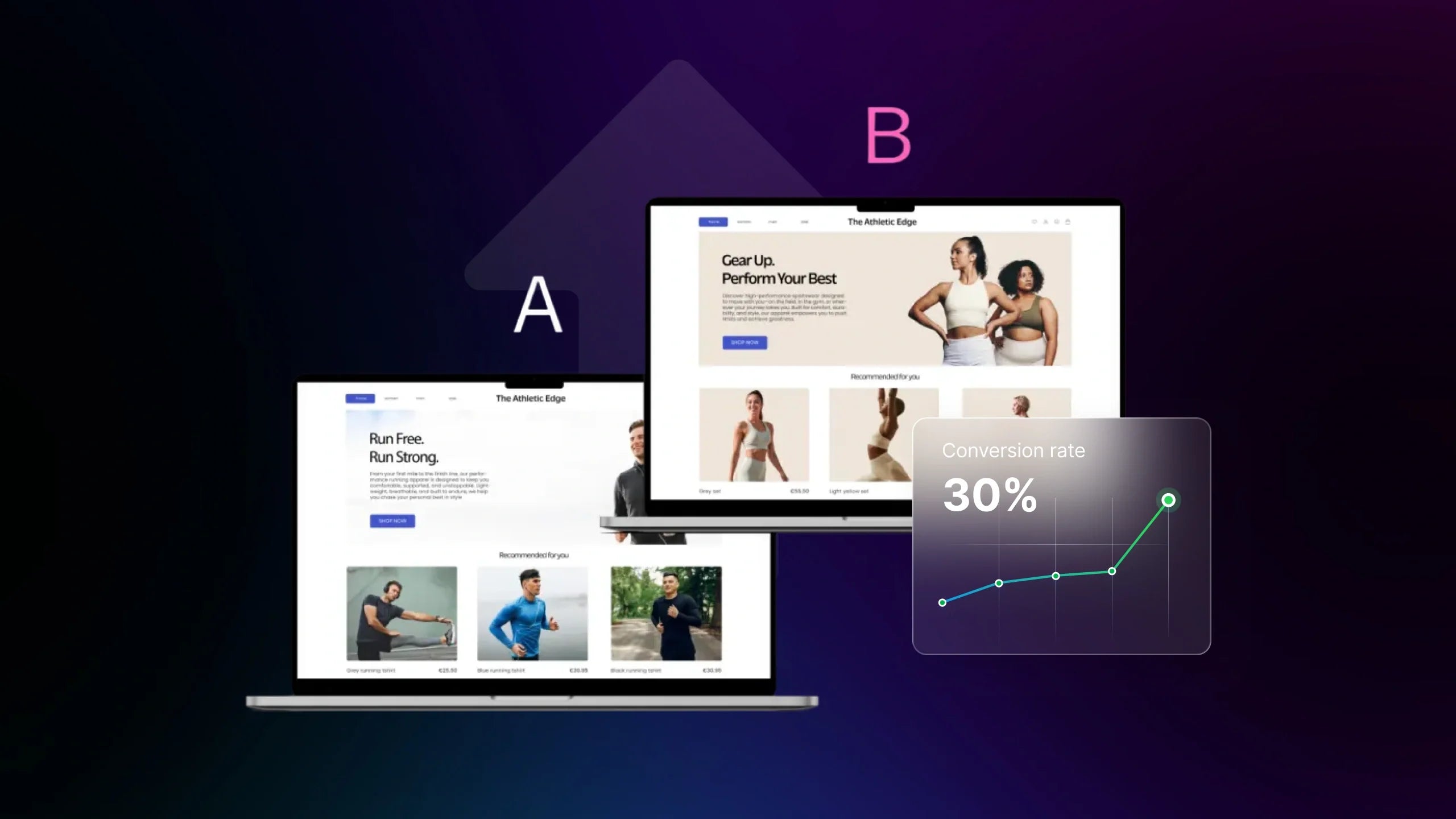
In eCommerce, A/B testing refers to controlled experiments where merchants compare two or more variations of a page, feature, or offer to understand which version drives higher conversion or revenue.
Unlike generic website testing, e-commerce A/B testing focuses on commercial outcomes such as product discovery, add-to-cart behavior, checkout completion, and customer lifetime value.

In this context, testing often targets product detail pages (PDPs), pricing strategies, cart design, checkout flows, and merchandising layouts. These areas directly influence how shoppers perceive value, reduce friction, and complete purchases.
This separates A/B testing from ad-hoc optimization. Ad-hoc changes rely on intuition, opinions, or imitation of trends. Structured experimentation relies on hypotheses, controls, measurable outcomes, and repeatability. The difference is scale. Isolated tests create isolated wins. Structured experimentation builds systems that improve performance across the entire funnel over time.
Why A/B Testing Is Crucial for E-commerce Business
Growth often stalls when traffic scales faster than conversion. Stores can spend more on ads, but without on-site conversion, acquisition costs rise and profitability declines. A/B testing helps break this ceiling by improving how existing traffic converts.
-
Breaks the traffic-to-conversion ceiling
A/B testing helps businesses unlock growth by increasing the percentage of visitors who take meaningful actions, such as adding to cart or purchasing. Even small conversion gains at high-traffic stages can produce a significant revenue impact without increasing acquisition spend.
-
Replaces assumptions with validated decisions
Many decisions are driven by intuition, internal opinions, or generic best practices, which often fail to reflect real customer behavior. A/B testing replaces subjective judgment with evidence and helps validate changes, improvements, or stalls. This reduces uncertainty and ensures that decisions really drive outcomes.
-
Reduces conversion risk as changes scale
As businesses grow, even a simple redesign or pricing adjustment can negatively affect thousands of sessions per day. A/B testing reduces this risk by allowing change evaluation with controlled traffic before full rollout. This protects revenue while enabling merchants to scale faster with confidence.
-
Creates compounding revenue improvements over time
The power of A/B testing lies in continuos learning process. Over time, incremental gains across product pages, funnels, and offers compound into substantial revenue growth. Instead of relying on one-time optimizations, businesses develop a sustainable system for continuous performance improvement.
High-Impact A/B Testing Ideas for Ecommerce Funnels
E-commerce funnels consist of multiple steps, and A/B testing ideas should align with these to maximize impact. Some experiments influence first-click behavior, while others drive add-to-cart or checkout completion. Prioritization should follow the impact of the funnel, not design trends. Here are some testing ideas
1. Headlines and Value Propositions
Headlines, subheadlines, and primary value propositions on product pages, collection pages, and landing pages. This includes benefit framing, outcome-driven messaging, risk reversal language, and differentiation versus competitors.
The headline is often the first element a shopper processes. If the value is unclear, irrelevant, or generic, users hesitate or bounce before engaging further. Strong value propositions reduce cognitive effort and help shoppers quickly decide whether a product is worth exploring, which directly affects interaction and add-to-cart behavior.

Testing a feature-focused headline, “Made with organic ingredients," against an outcome-focused version, “Clearer skin in 14 days, without irritation," on a product detail page to measure impact on add-to-cart rate rather than scroll depth alone.
Learn more: GemX Use Case Series: A/B Test Multiple Headlines
2. Calls to Action (CTA)
CTA copy, size, color contrast, placement, and contextual messaging. This includes testing action-oriented language, reassurance cues near the CTA, and primary vs secondary CTA hierarchy.
CTAs translate intent into action. Ambiguous or passive CTAs create hesitation at critical moments. Clear, intent-aligned CTAs reduce decision friction and make the next step feel safe and obvious, improving funnel progression.

Testing "Sign up for free vs "Trial for free" combined with a subtle shipping reassurance below the button to evaluate lift in add-to-cart and checkout initiation.
3. Forms and Friction Points
Form length, field order, required versus optional inputs, inline validation, guest checkout options, and error messaging within cart and checkout flows.
Every additional input increases cognitive load and abandonment risk. Removing unnecessary friction allows motivated shoppers to complete actions without interruption, especially on mobile, where effort tolerance is lower.

Testing a shortened checkout form with fewer required fields against the existing flow to measure checkout completion rate and abandonment reduction.
4. Above-the-Fold Experience
Hero imagery, headline placement, trust badges, key benefits, and visual hierarchy above the fold, especially on mobile-first layouts.

Shoppers decide within seconds whether a page is relevant. A strong above-the-fold experience establishes trust, communicates value, and guides attention before users scroll, directly impacting bounce rate and engagement depth.
Testing a hero section that prioritizes product benefits and reviews versus one focused on lifestyle imagery to evaluate impact on engagement and add-to-cart initiation.
5. Product Listing and Merchandising Layouts
Grid density, image size, default sorting logic, filter visibility, badges (best seller, new), and price presentation on collection pages.
Efficient product discovery reduces frustration and speeds up decision-making. Better merchandising helps shoppers find relevant products faster, increasing product views and add-to-cart volume without increasing traffic.

Testing “Best sellers” as the default sort versus “Newest arrivals” to measure changes in click-through rate and revenue per visitor.
Learn more: Shopify Product Page A/B Testing: A Practical Guide to Higher Conversions
6. Social Proof and Trust Signals
Placement and format of reviews, ratings, testimonials, guarantees, and third-party trust badges across PDPs and checkout pages.
Trust signals reduce perceived risk. When shoppers see validation from other buyers, they feel more confident completing purchases, especially for higher-priced or unfamiliar products.

Testing customer reviews displayed above the fold versus below product descriptions to evaluate the impact on add-to-cart and conversion rate.
7. Messaging and Body Copy
Long-form versus concise copy, benefit-led versus feature-led messaging, tone of voice, and section sequencing within product pages.
Body copy supports evaluation for shoppers who need more information before committing. Clear, relevant messaging answers objections and reinforces value without overwhelming users.

Testing a simplified benefit-focused description against a detailed technical explanation for a skincare product to measure changes in conversion rate and scroll engagement.
8. Pricing, Promotions, and Offers
Discount framing, bundles, anchor pricing, free shipping thresholds, payment plans, and promotional messaging placement.
Shoppers rarely evaluate price in isolation. Perceived value, fairness, and savings cues strongly influence purchase decisions. Strategic pricing tests improve conversion without necessarily lowering margins.

Testing “Free shipping over $75” versus a bundled offer “Buy 2, save 10%” to assess the impact on average order value and revenue per visitor.
9. Landing Page Layout and Content Hierarchy
Section order, content grouping, visual emphasis, and information hierarchy on campaign and paid traffic landing pages.
Clear structure reduces cognitive load and helps users process information in the right sequence. Well-organized pages support faster decision-making and higher conversion from paid traffic.

Testing a landing page that surfaces social proof immediately after the hero section versus one that introduces features first to evaluate the impact on conversion rate.
Learn more: Test what matters: The Perfect Route to Effective Website A/B Testing
How to Turn Testing Ideas Into Valid Experiments
Turning A/B testing ideas into reliable ecommerce experiments requires structure and discipline. Without a clear framework, even strong ideas can produce misleading results or false confidence. The following five steps focus on rigor, clarity, and business relevance, ensuring each test produces insights that can be trusted and scaled.
Step 1: Formulate Clear, Testable Hypotheses
Every experiment should begin with a hypothesis that explains why a change is expected to work, not just what will change. A strong hypothesis connects an observed friction point to a specific user behavior and a measurable outcome.
For example, if users hesitate on the product page due to unclear value, then clarifying the headline may increase add-to-cart rates. This step turns raw A/B testing ideas into learning objectives, ensuring the test generates insight even if the result is neutral or negative.
Step 2: Define Test Variables and Controls
A valid experiment isolates a single variable so its impact can be measured accurately. This means clearly defining the control (the existing experience) and the variant (the proposed change), while keeping all other elements constant.
Avoid layering multiple changes into one test, as this makes it impossible to attribute performance differences to a specific cause. Isolation is what transforms experimentation from guesswork into evidence-based decision-making.
For example, with GemX, you can easily conduct either template or multivariate experiments.


Create experiments with GemX to make testing a structured system
When creating the control and variant versions, it is important to make sure that only the testing elements are changed to ensure results remain valid. After that, adding version to begin the test.
Step 3: Select Success Metrics Before Launch
Success metrics must be selected before the experiment goes live. Primary metrics should reflect meaningful business progress, such as conversion rate or revenue per visitor, while secondary and guardrail metrics help explain behavior and protect against unintended harm.

Predefining metrics prevents hindsight bias, where teams declare success based on whichever metric happens to move. This step ensures A/B testing ideas are evaluated against outcomes that actually matter.
Step 4: Ensure Sufficient Sample Size and Test Duration
Statistical validity depends on having enough data. Before launching, teams should estimate the required sample size and minimum test duration based on traffic volume and desired confidence level.
Ending tests too early is one of the most common causes of false winners. During the experiment, interim checks should focus on data quality and tracking accuracy, not on declaring results. Patience is essential for trustworthy conclusions.
Step 5: Run Tests, Interpret Results, and Document Learnings
Once statistical confidence is reached, results should be analyzed holistically. Primary metrics determine whether the test succeeded, while diagnostic metrics explain why performance changed. Importantly, outcomes should be reviewed in the context of long-term business impact, not short-term gains.
Regardless of the result, documenting hypotheses, metrics, and insights ensures each experiment strengthens the overall experimentation system. Over time, this turns individual A/B testing ideas into a repeatable growth engine.
Learn more: How to Build an Experiment Roadmap for Consistent Growth
Which Metrics Validate E-commerce A/B Testing Ideas
Not all metrics are created equal in e-commerce experimentation. Validating A/B testing ideas requires separating metrics that explain why users behave a certain way from metrics that confirm whether the experiment actually created business value. Without this distinction, teams risk declaring wins that improve engagement but fail to move revenue, or worse, harm it downstream.
1. Defining Primary vs. Secondary Success Metrics
Primary metrics, such as purchase completion or add-to-cart rate, can determine experimentation success. Every A/B test must define its primary metric before launch, based on clear business goals.
Secondary metrics, such as scroll depth and time-on-page, help explain how users interacted differently with a variant. A disciplined approach to primary and secondary metrics ensures that A/B testing is evaluated consistently and helps keep optimization efforts aligned with actual goals.
2. Conversion Metrics vs. Revenue Impact Metrics
Conversion metrics measure whether users complete a defined action, such as checkout completion or overall conversion rate. These metrics are essential as they reflect movement through the ecommerce funnel and help identify friction or clarity improvements.
Revenue impact metrics, such as revenue per visitor or average order value, capture the financial impact of A/B tests. A test that increases conversion rate but lowers order value may produce misleading short-term wins while reducing long-term profitability. Hence, impactful A/B tests use multiple metrics to ensure result validity.
3. Avoid False Positives and Vanity Metrics
False positives occur when an experiment appears successful due to noise, incomplete analysis, or over-reliance on diagnostic signals. To avoid this, merchants should ensure tests show consistency across testing metrics and funnels.
Clear metric hierarchy, success criteria, and statistical confidence are core drivers of reliable A/B tests. When metrics are used correctly, they protect teams from scaling changes that produce short-term gains but fail in the long run.
Building a Repeatable A/B Testing Program for E-commerce Growth
Individual experiments can deliver incremental gains, but sustainable e-commerce growth comes from building a system that compounds learnings over time. A repeatable A/B testing program transforms isolated tests into a structured engine for continuous optimization. Here are some benefits of a systematic A/B testing system:
-
From Isolated Tests to Experimentation Programs
Many stores begin with random tests driven by design ideas or competitor inspiration. While this can produce occasional wins, it rarely scales. A programmatic approach connects A/B testing ideas to funnel stages, business priorities, and customer behaviors. This ensures experiments are prioritized based on impact, not personal preference.
-
Documenting Learnings and Building Institutional Knowledge
Documenting hypotheses, outcomes, and interpretations creates a shared knowledge base that improves future decision-making. Over time, this documentation reduces repeated mistakes, improves hypothesis quality, and accelerates experimentation velocity. Teams stop relearning the same lessons and start building on proven insights.
-
Scaling Experimentation Across Teams and Channels
A repeatable program enables insights from one channel, such as paid landing pages, to inform optimization across funnel steps. Scaling means testing more intelligently, with consistent metrics, shared frameworks, and clear goals. When testing is embedded into planning, execution, and change evaluation, experimentation becomes a core growth capability rather than a side project.
Conclusion
Having A/B testing ideas for eCommerce businesses provides a structured path from intuition to measurable growth. By prioritizing high-impact funnel areas, forming clear hypotheses, and validating results with meaningful metrics, ecommerce teams can systematically increase conversion and revenue. Over time, a disciplined experimentation program transforms optimization into a compounding growth engine.
FAQs


