


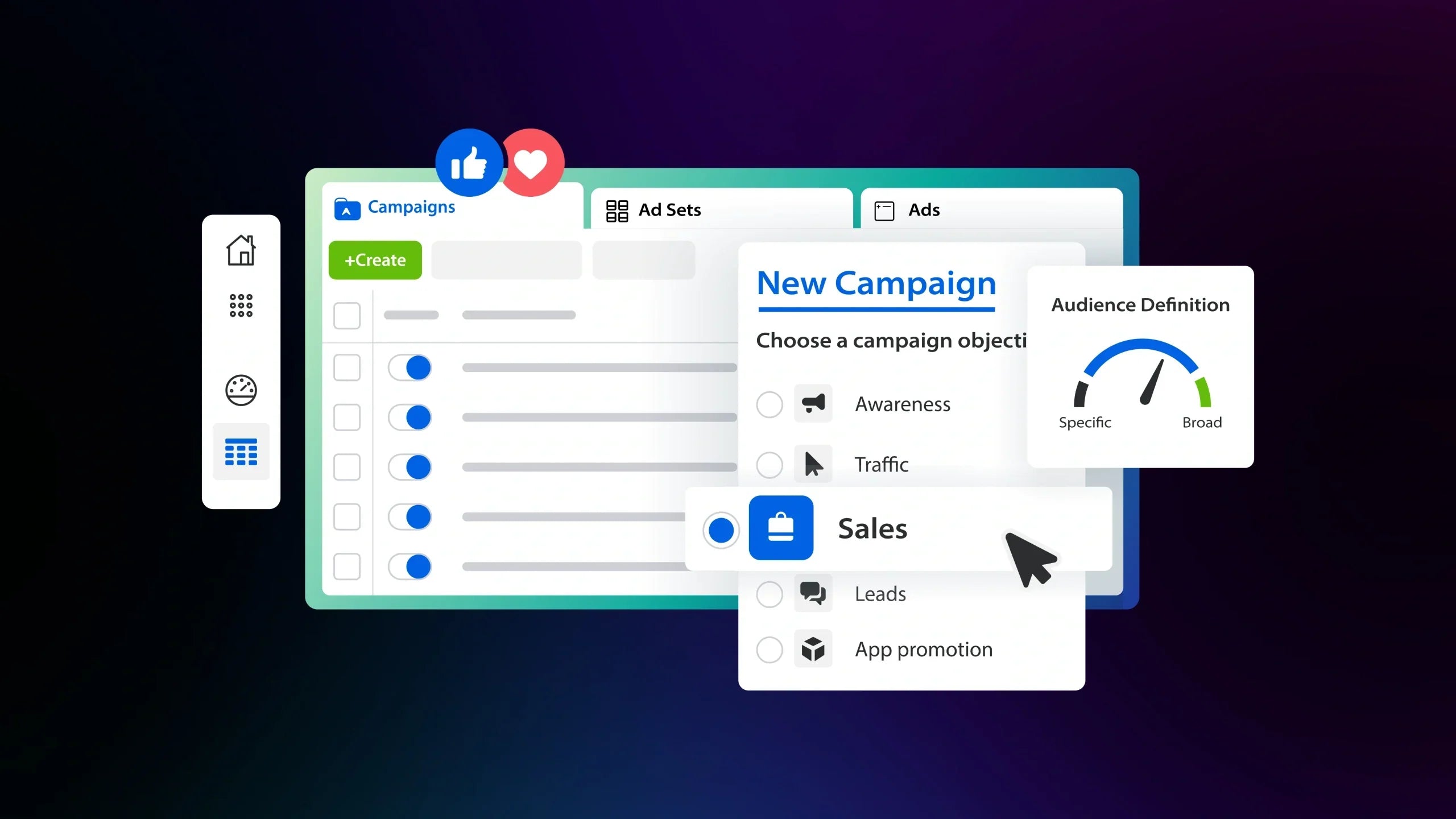
- What Is Performance Advertising
- Why Performance Advertising Drives Profitable Ad Spend
- Performance Advertising Framework That Drives Profitable Ad Spend
- Key Metrics That Power Performance Advertising
- Common Performance Advertising Mistakes That Reduce Profit
- How to Build a Performance Advertising Framework for Your Business?
- Final Words
- FAQs about Performance Advertising
Performance advertising is not about spending more on ads. It’s about building a system that turns media spend into predictable, profitable growth.
As acquisition costs rise and competition intensifies, advertisers who rely on isolated tactics or channel-level optimizations struggle to scale without sacrificing margins. What separates profitable advertisers from those who merely spend is a clear performance advertising framework: one that aligns traffic quality, conversion efficiency, and cost control across the entire funnel.
In this article, we break down the framework behind performance advertising and explain how it powers profitable advertising at scale without chasing vanity metrics or unsustainable spending increases.
What Is Performance Advertising
Performance advertising is a results-driven digital marketing approach where advertising efforts are directly tied to measurable business outcomes. In the modern digital landscape, it functions as a system that moves beyond isolated campaigns, combining paid media, data tracking, analytics, and conversion optimization to ensure that media spend can be attributed to tangible results such as conversions and revenue.
The core objective of performance advertising is to drive measurable business outcomes that directly impact revenue and profitability. Instead of focusing on impressions, clicks, or reach, performance advertising prioritizes metrics that reflect real commercial impact: how efficiently customers are acquired, how much revenue is generated, and whether growth remains profitable as budgets scale.
How performance advertising differs from other advertising approaches:
-
Brand advertising: Focuses on long-term awareness and perception, while performance advertising optimizes for direct, measurable outcomes such as conversions and revenue.
-
Paid media execution: Refers to the tactical act of running ads, whereas performance advertising provides the strategic framework that connects media performance to business results.
-
Short-term campaign-based advertising: Emphasizes temporary pushes and short-lived wins, while performance advertising is built as an always-on system designed for repeatable, scalable growth.
The typical outcomes of performance advertising include predictable revenue growth, improved customer acquisition cost (CAC) efficiency, stable or scalable return on ad spend (ROAS), and long-term increases in customer lifetime value (LTV). These outcomes reflect the core value of performance advertising: enabling sustainable, profitable growth without relying on vanity metrics or unsustainable spending increases.

Why Performance Advertising Drives Profitable Ad Spend
As advertising costs continue to rise and competition intensifies across digital channels, profitability has become the defining challenge for modern advertisers. Scaling ad spend without eroding margins requires more than tactical optimization. It demands a performance-driven approach that connects media investment directly to business outcomes.

Performance advertising drives profitable ad spend
Prioritizes Revenue Over Reach
Performance advertising drives profitable ad spend by structuring media investment around revenue contribution and commercial impact. Performance strategies assess success through the ability of ad spend to generate measurable returns, including revenue and margin contribution. This approach ensures that budget allocation decisions are guided by financial outcomes, enabling advertisers to identify which channels, audiences, and creatives directly support revenue growth.
By prioritizing revenue-focused metrics, performance advertising prevents inefficient scaling driven by inflated visibility numbers. Spending is increased only when incremental revenue justifies additional investment, creating a direct link between media efficiency and profitability. This discipline allows advertisers to grow spending predictably while protecting margins, even as acquisition costs increase across digital platforms.
Attracts Higher-Intent Traffic
A core driver of profitability in performance advertising is its ability to consistently attract higher-intent users. Performance frameworks rely on intent signals such as search behavior, engagement patterns, historical conversion data, and contextual relevance to reach users who are already closer to making a purchase decision. This targeting approach minimizes wasted impressions and focuses on audiences with demonstrated demand.
Higher-intent traffic improves downstream efficiency across the funnel. When users arrive with clear purchase or problem-solving intent, conversion rates increase, cost per acquisition decreases, and ad spend produces more reliable returns. Over time, this compounding effect enables advertisers to scale traffic volume without sacrificing efficiency, a critical requirement for sustainable growth.
Optimizes Conversion Efficiency Across the Funnel
Performance advertising extends beyond traffic acquisition by systematically optimizing conversion efficiency across every stage of the funnel. Ads, landing pages, messaging, and user experience function as interconnected components within a single performance system. Continuous testing and optimization improve how effectively traffic converts from click to lead, from lead to customer, and from customer to repeat buyer.
By improving conversion rates at multiple funnel touchpoints, performance advertising increases the value extracted from each visitor. This means advertisers can generate higher revenue from the same traffic volume, reducing the need for aggressive budget increases. Funnel-level optimization transforms ad spend from a cost center into a scalable growth lever.
Learn more: Website Speed Optimization Service for Faster Pages and Higher Conversions
Aligns Cost Control With Business Metrics
Performance advertising drives profitability by tightly aligning cost control mechanisms with core business metrics such as customer acquisition cost (CAC), return on ad spend (ROAS), and customer lifetime value (LTV). Spending decisions are guided by real-time performance data and adaptive thresholds, enabling advertisers to respond quickly to changes in efficiency and unit economics.
This alignment ensures that growth remains financially sustainable as scale increases. When costs rise or performance declines, performance advertising frameworks enable rapid optimization or reallocation to protect margins. By anchoring media spend to business-level metrics, advertisers maintain long-term control over profitability while continuing to expand their advertising investment.
Performance Advertising Framework That Drives Profitable Ad Spend
Profitable advertising at scale is not the result of isolated optimizations or channel-specific tactics. It is driven by a performance advertising framework that aligns demand validation, traffic efficiency, conversion optimization, and measurement into a single operating system. Advertisers who lack this framework often experience diminishing returns as spending increases, while those who adopt it can scale predictably without sacrificing margins.

Performance advertising framework
Below is a detailed breakdown of the four foundational layers that enable performance advertising to drive sustainable, profitable growth.
Framework 1: Demand & Intent Layer
At the foundation of performance advertising is the demand and intent layer, which determines whether advertising spend can convert efficiently before any media execution begins. Performance advertising starts by identifying where genuine demand exists and how ready users are to take action, with creative execution serving to activate and capture that demand.
This layer focuses on analyzing search intent, problem awareness, and buying readiness. Users expressing high-intent signals, such as solution-aware search queries, comparison behavior, or repeated engagement, represent significantly higher conversion probability than broad, awareness-stage audiences. Performance advertising prioritizes these signals because intent directly influences conversion rate, acquisition cost, and revenue predictability.
Without validated demand and intent, even the most compelling creatives or sophisticated bidding strategies fail to scale profitably. This is why performance advertising always begins with intent mapping, audience qualification, and demand validation, ensuring that paid media amplifies existing demand instead of compensating for its absence.
Framework 2: Traffic Quality & Cost Efficiency
Once demand is confirmed, performance advertising shifts focus to traffic quality and cost efficiency, recognizing that not all traffic contributes equally to revenue. This framework requires a nuanced understanding of auction mechanics, including CPC, CPM, Quality Score, relevance signals and platform-specific delivery algorithms.
A common scaling mistake is optimizing aggressively for low CPC or low CPM, assuming lower costs automatically improve profitability. In practice, low-cost traffic often correlates with low intent, poor engagement, and weak downstream performance. Performance advertising evaluates traffic quality based on how users behave after the click, how they engage with the funnel, convert, and generate revenue.
Optimizing for efficiency means balancing cost with outcome. Media decisions are guided by how traffic performs across the funnel, not by isolated auction metrics. This approach allows advertisers to avoid volume-driven inefficiencies and maintain stable unit economics as spending scales across competitive auctions.
Framework 3: Conversion & Funnel Optimization
Traffic efficiency alone cannot drive profitable growth without conversion and funnel optimization, which is where performance advertising creates compounding returns. This framework ensures that ad messaging, landing pages, offers, and post-click experiences are tightly aligned to reduce friction and maximize value extraction from every visitor.
Performance advertising treats the funnel as a dynamic system that evolves with traffic and scale. Conversion rate optimization (CRO) functions as a core performance lever, defining how efficiently spend can expand over time. As budgets increase, unresolved funnel inefficiencies compound acquisition costs unless they are addressed through systematic optimization.
This is where GemX functions as critical performance infrastructure, enabling advertisers to optimize conversion efficiency with precision and evidence. Within a performance advertising framework, GemX supports:
-
Template testing and Multipage testing to validate page structures, messaging hierarchy, and offer presentation across templates and user flows.
-
Experiment Analytics to analyze test results and quantify the impact of performance changes on key metrics such as conversion rate, average order value, and funnel completion.
-
Page Analytics to evaluate performance metrics for any individual page across the store, supporting deeper insight beyond isolated landing page views.
-
Journey Analysis to understand user navigation patterns across the site and identify behavioral drop-offs, friction points, and leakage points within customer journeys.
-
Order-level reporting and revenue attribution insights to trace revenue outcomes back to traffic sources and on-site interactions across the conversion journey.

By continuously improving funnel performance, advertisers increase revenue per session and extend the point at which additional spending remains profitable. In practice, funnel performance sets the ceiling for sustainable advertising scale long before media capacity is exhausted.
Framework 4: Measurement, Attribution & Incrementality
The final framework focuses on measurement accuracy and incrementality, which are essential for making correct scaling decisions. Attribution models assign conversion credit, but attribution alone does not measure whether advertising actually created incremental value.
Performance advertising requires separating reported performance from true business impact. This involves understanding the limitations of last-click, multi-touch attribution, and platform-reported conversions, all of which can distort decision-making at scale. Incrementality testing, lift analysis, and profit-based evaluation provide a more reliable foundation for optimization.
By focusing on incrementality, advertisers prevent scale decisions from being driven by channels that simply harvest existing demand. This framework ensures that performance signals represent genuine contributions to growth, protecting budgets from over-investment influenced by misleading attribution data.
These four frameworks create a closed-loop performance system. Demand and intent ensure relevance, traffic efficiency controls acquisition costs, conversion optimization maximizes value extraction, and measurement validates true impact. When aligned, this system allows advertisers to scale spending with confidence, maintaining efficiency, protecting margins, and driving long-term growth without relying on vanity metrics or unsustainable budget increases.
Key Metrics That Power Performance Advertising
Performance advertising is only as strong as the metrics used to guide decision-making. Unlike traditional advertising, where success is often inferred from visibility or engagement, performance advertising relies on financially grounded, decision-enabling metrics that inform how budgets are allocated, optimized, and scaled. Below are the three core metric groups that power effective performance advertising systems.

Key metrics that power performance advertising
Group 1: Efficiency Metrics
Efficiency metrics measure how effectively advertising spend converts into desired outcomes. They form the foundation of day-to-day optimization and help advertisers understand whether campaigns are operating within acceptable cost thresholds.
-
Cost Per Acquisition (CPA): Measures the average cost required to acquire a customer or conversion. In performance advertising, CPA is not treated as a static benchmark but as a variable that must be evaluated relative to conversion quality, funnel stage, and downstream revenue.
-
Return on Ad Spend (ROAS): Evaluates how much revenue is generated for every unit of advertising investment. Although widely used, ROAS requires careful interpretation within performance advertising. Platform-reported ROAS typically reflects attributed revenue, which functions as a directional efficiency signal.
-
Cost per incremental conversion: Provides a more accurate efficiency signal by measuring the cost of conversions that would not have occurred without advertising. This metric helps advertisers avoid false efficiency caused by demand capture and ensures optimization decisions are grounded in true performance lift and incremental value creation.
Group 2: Growth & Scale Metrics
While efficiency metrics indicate whether advertising is working, growth and scale metrics determine how far it can be expanded without degrading returns. These metrics help advertisers identify scaling headroom and diminishing returns before profitability erodes.
Impression share measures the proportion of available qualified demand an advertiser captures within a given auction or channel. In performance advertising, impression share is used to diagnose whether growth constraints originate from budget limits, bid competitiveness, or funnel capacity, as opposed to external market saturation alone.
Marginal ROAS evaluates the return generated by incremental spend, focusing on performance at the margin instead of blended averages. This metric is critical for scaling decisions, as average ROAS can conceal efficiency decay at higher spend levels. Marginal ROAS identifies the point at which additional budget produces diminishing returns, signaling when to slow scaling or reallocate investment.
Conversion volume efficiency assesses how conversion volume changes relative to increases in spend. Instead of focusing solely on cost metrics, this measure evaluates whether higher budgets produce proportional growth in conversions, helping advertisers distinguish healthy scale from volume-driven inefficiency.
Group 3: Profitability Metrics
True performance advertising optimization ultimately depends on profitability metrics, which connect marketing performance to business sustainability. These metrics ensure that growth remains financially viable beyond short-term campaign results.
Contribution margin measures the profit remaining after variable costs, including advertising spend, are deducted from revenue. In performance advertising, contribution margin provides a clearer picture of whether campaigns are creating economic value, especially for businesses with complex cost structures or thin margins.
LTV:CAC ratio compares the lifetime value of a customer to the cost of acquiring them. This metric is central to performance advertising strategy, as it defines how aggressively a business can invest in acquisition while maintaining long-term profitability. A healthy LTV:CAC ratio enables controlled scaling even when short-term efficiency metrics fluctuate.
Payback period measures how long it takes for acquired customers to generate enough revenue to recover acquisition costs. Shorter payback periods reduce cash flow risk and allow faster reinvestment into growth, making this metric particularly important for scaling performance advertising in capital-sensitive environments.
Learn more: Advertising Metrics: How to Turn Ad Performance Data Into Real Business Growth
Common Performance Advertising Mistakes That Reduce Profit
Even with advanced tools and sophisticated ad platforms, many advertisers struggle to maintain profitability as spending increases. In most cases, declining returns are not caused by platform limitations but by systemic mistakes in how performance advertising is planned, measured, and scaled. Understanding these common pitfalls is essential for protecting margins and building sustainable growth.
Below are the most frequent performance advertising mistakes that directly reduce profit.

Common performance advertising mistakes
Optimizing for Clicks Instead of Conversions
One of the most common mistakes in performance advertising is optimizing campaigns around click volume instead of conversion or revenue outcomes. Clicks are easy to generate and simple to measure, yet they offer limited insight into commercial intent. Elevated click-through rates can obscure weak conversion performance, encouraging advertisers to scale spending on traffic that fails to generate meaningful revenue.
Performance advertising requires optimization signals that reflect business impact, not surface-level engagement. When campaigns are optimized for conversion events, downstream behavior or revenue-based objectives, budget allocation becomes aligned with outcomes that matter. Focusing on clicks alone inflates activity metrics while quietly eroding profitability.
Scaling Budgets Before Funnels Are Stable
Another critical mistake is increasing ad budgets before the conversion funnel is proven and stable. Scaling spend amplifies existing inefficiencies; if the funnel contains friction, messaging misalignment, or technical issues, higher budgets simply increase losses at a faster rate.
Performance advertising depends on funnel readiness. Before scaling, advertisers must validate conversion rates, user flow consistency, and post-click experience across devices and traffic sources. Without a stable funnel, incremental spend produces diminishing returns, making budget growth unsustainable regardless of media efficiency.
Relying on Vanity Metrics and Averages
Many advertisers rely on vanity metrics, such as impressions, reach, or average ROAS, to assess performance. While these metrics may indicate surface-level activity, they often obscure critical performance insights. Averages, in particular, hide distributional effects such as declining marginal returns, audience saturation or inefficient spending at higher budget tiers.
Performance advertising requires granular analysis across audiences, spend levels, and funnel stages. Evaluating marginal efficiency instead of blended averages allows advertisers to detect early signs of performance decay and adjust investment before profitability erodes. Vanity metrics can create a false sense of success while concealing underlying structural inefficiencies.
Metrics Without Decision Activation
A final and often overlooked mistake is treating performance metrics as static reports instead of actionable optimization signals. Many teams review dashboards retrospectively without using performance data to actively guide experimentation, budget reallocation, or funnel improvements.
In performance advertising, metrics must inform decisions in near real time. CPA, ROAS, conversion rates, and profitability indicators should trigger specific actions, such as testing new creatives, refining audiences, adjusting bids, or optimizing landing pages. When metrics are reduced to reporting artifacts, performance advertising loses its adaptive advantage, and profitability declines as conditions change.
Avoiding these common mistakes enables performance advertising to function as a scalable growth system rather than a cost center. By optimizing for outcomes, stabilizing funnels before scaling, analyzing performance beyond vanity metrics, and using data as an active decision engine, advertisers can protect margins and drive sustainable, profitable growth.
Learn more: A/B Testing Companies for Shopify: Avoiding Bad Tests and Wrong Decisions
How to Build a Performance Advertising Framework for Your Business?
Building a performance advertising framework requires designing an operating model that links demand, media execution, conversion efficiency, and measurement into a single system. When these elements are aligned, advertising spend becomes predictable, controllable, and scalable.

05 steps to build a performance advertising framework
Step 1: Define Profit-Driven Objectives
A performance advertising framework begins with clearly defined, profit-driven objectives. These objectives establish the financial boundaries within which advertising activity must operate. Core inputs typically include revenue targets, acceptable customer acquisition cost (CAC) thresholds, and contribution or gross margin requirements.
By anchoring advertising goals to unit economics, businesses ensure that performance decisions remain grounded in financial reality. Profit-driven objectives provide a reference point for evaluating campaign efficiency, funnel performance, and scaling readiness. As budgets grow, these objectives help maintain discipline by ensuring that growth aligns with long-term profitability expectations.
Step 2: Map Intent to Funnel Stages
Effective performance advertising aligns user intent with appropriate funnel stages. Different traffic sources express different levels of readiness, ranging from early problem awareness to high-intent purchase behavior. Mapping intent signals to funnel experiences ensures that users encounter messaging, offers, and calls to action that match their current decision stage.

This alignment improves conversion efficiency by reducing friction and increasing relevance. High-intent users are guided toward direct conversion opportunities, while exploratory users receive context, education, or validation that supports progression through the funnel. Over time, this structured intent mapping strengthens performance consistency and improves acquisition efficiency across channels.
Step 3: Optimize Ads and Landing Pages
Performance advertising depends on seamless alignment between ad messaging and on-site experience. Ads establish expectations around value, pricing, and outcomes, while landing pages must reinforce those expectations through clarity, relevance, and ease of interaction. Misalignment at this stage increases bounce rates and suppresses conversion performance.
Optimization efforts focus on message consistency, offer positioning, visual hierarchy, page speed, and friction reduction across forms and checkout flows. Continuous refinement of these elements improves conversion rates and increases revenue per visitor. As traffic scales, these gains compound, protecting efficiency and supporting sustainable growth.
Step 4: Measure Incrementality
Measurement is central to performance advertising, especially when budgets scale across multiple channels. Beyond attribution reporting, businesses must understand incrementality, how much growth is directly driven by advertising investment. Incrementality measurement clarifies which channels contribute genuine value and which primarily capture existing demand.
This insight improves decision quality by ensuring that budget allocation reflects true performance impact. Incrementality analysis supports more accurate forecasting, reduces dependency on platform-reported metrics and strengthens confidence in scaling decisions. When growth is evaluated through this lens, advertising investment remains aligned with real business outcomes.
Step 5: Test, Learn, and Scale Systematically
Sustainable performance advertising relies on structured experimentation and disciplined scaling. Testing establishes evidence for what improves efficiency and conversion outcomes, while learning turns those insights into repeatable patterns. Scaling occurs only after performance improvements are validated under controlled conditions.
At this stage, experimentation and optimization tools such as GemX function as core infrastructure within the performance advertising framework. By enabling teams to validate performance improvements through structured testing, they ensure that scaling decisions are supported by evidence and aligned with sustainable efficiency.
Systematic testing ensures that scaling decisions are grounded in data and performance stability. The framework remains adaptable across traffic sources by applying the same testing discipline to each new channel, creative variation or funnel configuration.
Final Words
Performance advertising delivers sustainable results when it is built as an operating system for growth, governed by economics, intent, and evidence-based decision-making. When profit-driven objectives, intent-aligned traffic, conversion efficiency, and accurate measurement work together, advertising investment becomes predictable and scalable at the business level.
In this system, experimentation and optimization infrastructure play a critical role. Platforms such as GemX enable organizations to institutionalize testing, surface funnel inefficiencies, and validate performance improvements before capital is committed at scale. This discipline transforms advertising from a cost center into a controlled growth engine, one that supports efficiency, protects margins, and compounds value over time.
FAQs about Performance Advertising


