


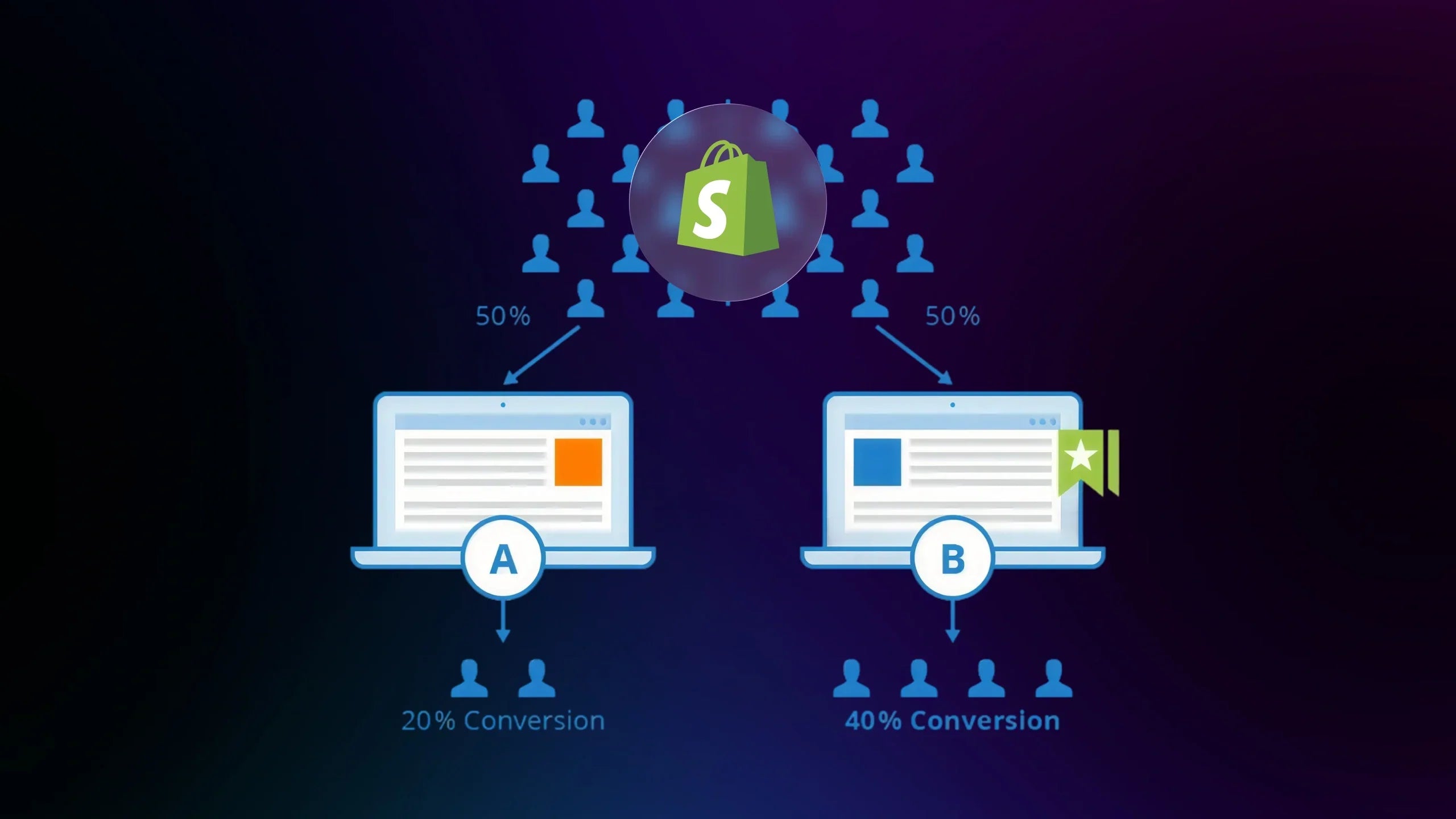
Many Shopify stores invest heavily in traffic but still struggle to convert visitors. This is why learning how to fix low conversion rate on Shopify with A/B testing has become a critical growth skill. Controlled experiments allow merchants to identify what actually blocks purchases or improves revenue.
But how to run effective A/B tests to boost conversion remains a great challenge for even high-performing stores. In this guide, we will help you fix low conversion rate on Shopify with A/B testing to increase sales with confidence.
What Is Considered as Low Conversion Rate?

Before changing layouts, pricing, or messages, it is important to understand what “low” really means in ecommerce. Conversion rate only becomes useful when compared to benchmarks, traffic sources, and customer intent. A store with strong product-market fit can struggle if its funnel design or messaging creates friction.
Average conversion rate
Across most Shopify stores, the average conversion rate falls between 1.5% and 3%. This means that out of every 100 visitors, roughly 1.5 to 3 people complete a purchase. Stores below 1% usually face major friction in their funnel, such as confusing pricing, weak trust signals, or slow pages.
For example, if your store receives 50,000 monthly visitors and converts at 0.8%, it generates about 400 orders. If that rate improves to 2%, it produces 1,000 orders from the same traffic. That difference is why merchants seek ways to fix low conversion rate on Shopify with A/B testing instead of spending more on ads.
Conversion rate should always be viewed alongside revenue per visitor. A store selling high-ticket products may have lower conversion but higher revenue, while a low-price store may rely on volume.

Average conversion rate by industry
Not all Shopify stores operate under the same conditions. For example, according to Statista, apparel stores often average 1.5% to 2.5%, while health and beauty brands tend to reach 2% to 4% when their trust and branding are strong. Digital products and subscription services can exceed 4% as checkout friction is lower.
A home decor store converting at 1.2% may be underperforming compared to its peers, while a luxury brand at 1.5% could be healthy. Understanding industry context helps decide whether you truly need to fix low conversion rate on Shopify with A/B testing or simply refine your offer.
Why Your Store Struggles With Low Conversion Rate?
Low conversion rates are rarely caused by a single issue. They result from friction across content, trust, clarity, and experience. A/B testing allows these problems to be identified and solved one at a time.
Poor page design and content relevance
Most low-converting Shopify pages fail as product information, content, and messages are unclear. When the value proposition, benefits, or differentiation are vague, users hesitate or leave within seconds. This contributes to high bounce rates and low add-to-cart rates, even when traffic quality is good.

The solution is to test content presentation. For example, one version of a page might lead with a strong benefit-driven headline, while another leads with lifestyle imagery. A/B testing helps identify better-performing versions, thereby optimizing resource allocation.
Lack of credibility and reassurance signals
Shoppers hesitate when they are unsure whether a store is legitimate or safe to buy from. Missing reviews, hidden policies, or weak brand signals increase buyer anxiety and reduce checkout completion, even if the product is attractive.
The solution is to strengthen credibility through social proof, policy clarity, brand signals, and other trust elements to reduce hesitation. For example, if a version with social proof raises checkout completion from 58% to 65%, it proves that credibility was a key barrier.
Confusing Pricing, Shipping, and Return Information
Unexpected costs and unclear policies are major drivers of cart abandonment. When shoppers do not understand the total price or what happens if they need to return a product, they delay or exit.

The solution is to test how offers are framed and disclosed. One version might show free shipping near the price, while another hides it until checkout. One might display return terms above the fold. If a more transparent layout increases completed checkouts by 10–20%, it confirms that clarity was the real issue.
Performance and Loading Speed issues
Slow or unstable pages quietly push users away, especially on mobile. Even a short delay can reduce conversions significantly and directly impact revenue.
The solution is to test faster, lighter layouts against heavier ones. By comparing a performance-optimized version of a page with a slower one, merchants can see how speed affects conversion. When the faster variant produces more purchases, it proves that technical friction was blocking sales.
Learn more: How to Optimize Your Website Speed Loading
Weak or Missing CTA Message
A vague or poorly placed call-to-action creates hesitation. Shoppers may want the product, but do not feel guided to the next step.

The solution is to test CTA wording, placement, and visibility. “Add to Cart” may outperform “Learn More,” and a button above the fold may outperform one below. The variant that generates more add-to-cart and checkout starts becomes the new standard.
Ongoing Conversion Optimization through Structured A/B Testing
Stores that do not test rely on guesswork. This leads to repeated mistakes and stalled growth.
The solution is to use continuous, structured experiments to validate every change. Each test teaches what customers respond to, allowing the store to improve conversion rates steadily instead of making risky, unproven updates.
Why A/B Testing Is the Safest Way to Fix Low Conversion Rates
Once a store is confirmed to be underperforming, the next challenge is how to improve it without risking existing revenue. Redesigns, new offers, or new messages can easily make things worse if they are deployed without proof. A/B testing allows merchants to measure changes in controlled environments before rolling them out to all customers.
#1. Validation
A/B testing provides data-driven validation of every design and content change. Instead of guessing whether a new product description, hero image, or pricing layout works better, merchants can compare two versions and see which produces more purchases.
For example, if Version A of a product page converts at 1.9% and Version B converts at 2.4%, the difference represents real buyer behavior. It also isolates friction inside specific funnel stages, such as product pages, cart pages, or checkout steps, so teams know exactly what to improve.
Learn more: How to Run High-Impact Experiments on Shopify
#2. Risk Control
Changing a live Shopify store always carries risk. A new layout might look better but perform worse. A new offer may confuse buyers. A/B testing reduces this risk by exposing only a portion of traffic to new versions while protecting the rest.
If a test variant performs 10% worse after receiving 10,000 visits, it can be stopped before harming total revenue. This controlled exposure is essential when trying to fix low conversion rate on Shopify with A/B testing at scale.
#3. Revenue Impact
A/B testing measures revenue before deployment. Instead of rolling out changes based on assumptions, merchants can see how each version affects conversion rate, average order value, and revenue per visitor.
For instance, a new upsell layout may slightly lower conversion but raise average order value enough to increase total revenue. Continuous testing ensures optimization aligns with real customer behavior and business goals.
How to Optimize Your Store Conversion Rate with A/B testing
After you have diagnosed the problems, the next action is to fix them. A/B testing is one of the most reliable ways to fix low conversion rate. But how to fix low conversion rate with A/B testing remains a challenge for even high-performing shops.
Step 1. Identify the Biggest Conversion Drop-offs
Before running any A/B test, you must know where money is being lost in your Shopify funnel. Most low-converting stores do not have a traffic problem. They have a leak problem. Visitors arrive, but too many drop out before reaching checkout.

Google Analytics helps identify drop-offs
Start by reviewing Shopify Analytics or GA4 to map your funnel:
-
Product views
-
Add-to-cart
-
Checkout started
-
Purchase
For example, if 1,000 users view a product but only 50 add it to their cart, the issue is likely on the product page. If many users add to cart but few reach checkout, pricing or shipping clarity may be the issue. A/B testing should always target the largest drop-off first to ensure you are fixing what actually limits your conversion rate, not just what looks wrong.
Step 2. Define the Primary Conversion Goal for Each Test
Each A/B test must be tied to one clear business outcome. Without a clear goal, results can become misleading, and it is impossible to determine whether a change has truly resolved the problem.
For example:
-
If the drop-off happens on the product page, your primary metric should be add-to-cart rate.
-
If it happens in checkout, your metric should be checkout completion rate.
-
If revenue is unstable, revenue per visitor is often the best choice.
By defining one primary goal, you ensure that every variation is judged on what matters most. Secondary metrics, such as time on page or bounce rate, can provide context, but they should never override the primary conversion signal. This discipline prevents stores from rolling out designs that look better but convert worse.
Step 3. Choose High-Impact elements to Test
Once you know where users drop off, you can select what to change. The goal is not to test random design tweaks, but to test the elements most likely to influence buying decisions.

On product pages, this often includes:
-
Headline and value proposition
-
Product images or video
-
Price and shipping display
-
Trust elements such as reviews or guarantees
-
Call-to-action wording and placement
In checkout, high-impact elements include shipping clarity, payment options, and reassurance messaging. A/B testing these areas directly addresses the psychological and practical reasons shoppers hesitate. This is how A/B testing becomes a tool to fix low conversion rate on Shopify, not just a design experiment.
Step 4. Form a Clear, Testable Hypothesis
Every test should be based on a hypothesis that connects a problem to a proposed solution.
A strong hypothesis follows this structure:
“If we change X, we expect Y to improve because Z.”
For example:
“If we move shipping information above the Add to Cart button, we expect checkout completion to increase because users will feel more confident about the total cost.”
This forces your team to think about why the conversion rate is low and how the test will fix it. It also makes results easier to interpret. If the test wins, you know what worked. If it fails, you learn which assumption was wrong.
Step 5. Launch the A/B Test and Monitor Key Metrics
When the test goes live, traffic should be split evenly between the control and the variant. During this period, your job is not to decide a winner, but to ensure the test is running cleanly.

You should monitor:
-
Traffic distribution between versions
-
Page load speed and errors
-
Unusual spikes from ads or promotions
A broken checkout button or tracking error can invalidate weeks of data. Monitoring protects the integrity of your A/B testing and ensures the numbers you analyze later are reliable.
Step 6. Analyze Results and Roll Out the Winning Variant
When enough data has been collected, compare performance using your primary conversion metric. A real winner should show a statistically significant improvement, not just a small fluctuation.
If a variation increases add-to-cart rate, checkout completion, or revenue per visitor with high confidence, it should be deployed across the store. This directly fixes part of your low conversion rate problem.
Just as important, document what worked and why. Over time, these learnings compound, allowing you to systematically improve how your Shopify store converts traffic into revenue.
Learn more: How to Apply The Winning Version Safely?
Real-world Examples: How A/B testing Saves Low Conversion Rates
#1. Product Detail Page CTA Test
A skincare store was getting strong traffic to its product pages, but fewer than 4% of visitors added products to their cart. Heatmaps showed that users were scrolling but hesitating near the call-to-action.

The store tested two versions of the product page. Version A used a generic “Buy Now” button. Version B used a stronger CTA, “Get Clear Skin Today,” and moved the button directly under the main product benefit.
After 18 days and over 20,000 sessions, Version B increased the add-to-cart rate from 3.9% to 5.4%. That single change raised monthly revenue by over 30% without increasing ad spend. The test worked because it directly addressed buyer motivation and clarity at the moment of decision.
#2. Checkout Messaging Test
An apparel brand noticed that many customers abandoned their carts after starting checkout. Surveys revealed that buyers were worried about shipping delays and return policies.

Two checkout versions were tested. One showed only the payment form. The other added a simple reassurance block above the payment fields:
“Free 30-day returns. Ships in 24 hours. Secure checkout.”
The reassurance version increased checkout completion from 61% to 69%. This change simply reduced buyer anxiety to encourage payment. This is a classic example of how A/B testing can fix low conversion rates by removing psychological barriers.
#3. Mobile vs. Desktop layout test

A store selling home accessories saw that mobile traffic made up 72% of visits but produced only half of the total sales. Desktop pages were converting well, but mobile users struggled to navigate the product layout. When testing a simplified mobile layout, it increased mobile conversion rate by 26% and lifted overall store revenue by 18%. Without A/B testing, the store would not have discovered that one layout worked well for desktop but failed on phones.
Conclusion
A low conversion rate on Shopify is rarely caused by one single issue. It is usually the result of frictions such as unclear messaging, missing trust signals, or confusing offers. Merchants can fix low conversion rate on Shopify with A/B testing, as it allows every improvement to be validated with real customer behavior before it is fully deployed.
By identifying where shoppers hesitate, testing high-impact elements, and applying only proven changes, merchants can turn existing traffic into sustainable growth. This structured approach creates a repeatable optimization system rather than a series of risky design changes.
FAQs


