


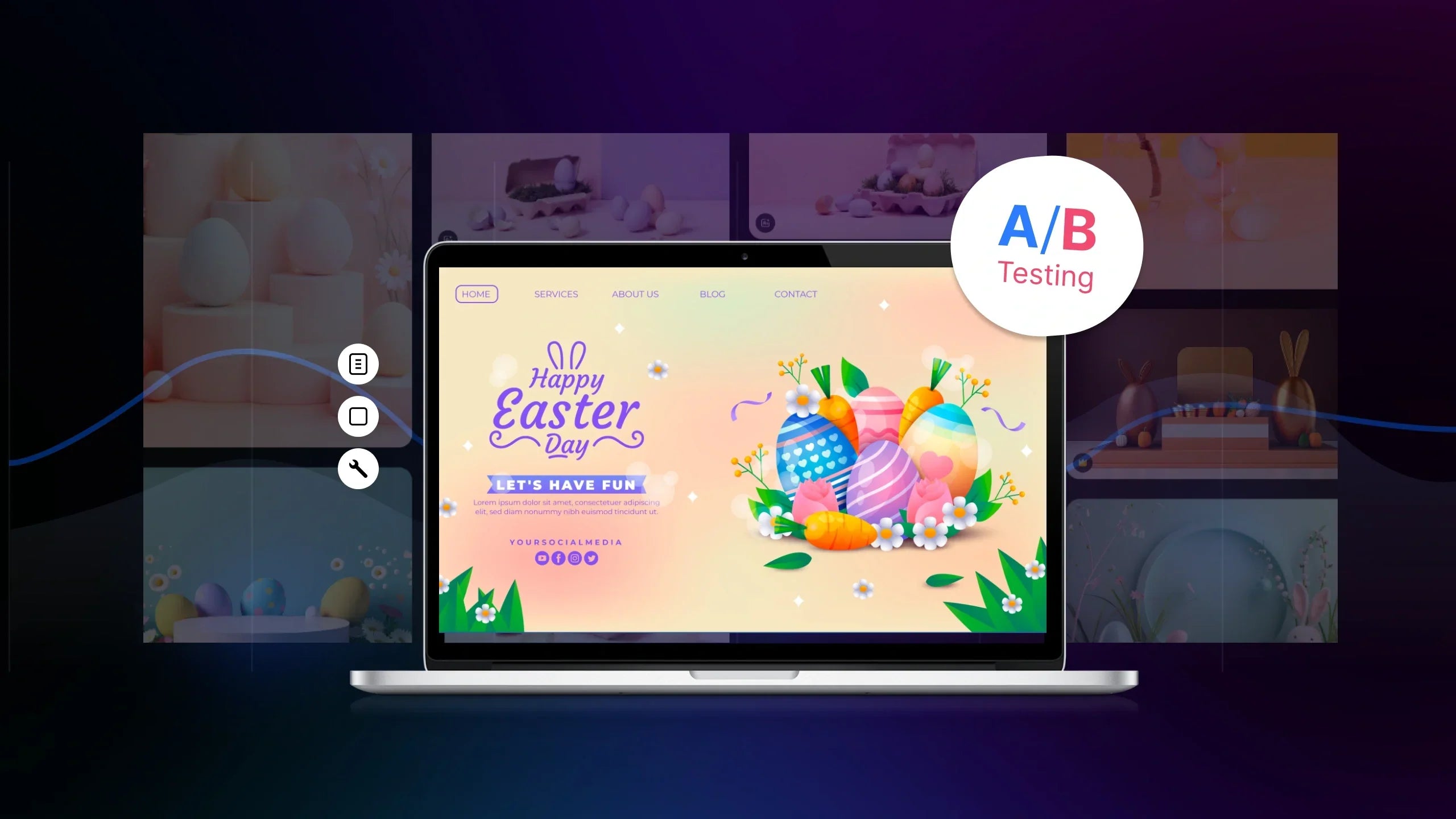
- Why Easter Is the Gold Time to Boost Your Store Revenue
- Why You Should A/B Test Your Easter Landing Page
- 30+ Testing Ideas That Lift Your Easter Landing Page
- How to Prioritize Your Easter A/B Testing Experiments
- How to Run Easter A/B Tests Without Slowing Down Your Campaign
- Common Mistakes in Seasonal A/B Testing
- Conclusion
- FAQs about Easter Landing Page A/B Testing
Easter campaigns look great on paper with traffic spikes, fresh creatives, and new offers. But when it comes to actual conversions, many Shopify stores hit the same wall: visitors come in, scroll a bit, and leave without buying.
Seasonal campaigns move fast, and there’s little room for trial and error. If your messaging, layout, or offer doesn’t match what shoppers expect in that exact moment, you’re leaving revenue on the table rapidly.
This is where Easter landing page A/B testing becomes your unfair advantage. Instead of guessing, you validate. Instead of redesigning everything, you test what matters.
In this guide, you’ll discover high-impact A/B testing ideas you can launch quickly to turn Easter traffic into real revenue.

Why Easter Is the Gold Time to Boost Your Store Revenue
Easter isn’t just another seasonal campaign, but it’s a high-intent buying window that many Shopify stores underestimate.
Unlike broader holidays, Easter shopping is compressed and purpose-driven. Customers are looking for quick wins: gifts, bundles, limited-time deals, and anything that feels “occasion-ready.” That means your landing page has a very short window to capture attention and convert.
Here’s what makes Easter especially impactful for revenue:
-
Spike in purchase intent: Shoppers are actively looking for gifts and promotions, not just inspiration
-
Short decision cycles: Most purchases happen within a few days, not weeks
-
Emotion-driven behavior: Visuals, themes, and messaging have a stronger influence on buying decisions
-
Higher AOV opportunities: Bundles, gift sets, and seasonal offers naturally increase cart value
But here’s the catch: this same dynamic also makes Easter campaigns fragile.
If your landing page doesn’t immediately match what users expect (clear offer, relevant visuals, strong CTA), they bounce. You don’t get a second chance because the campaign window is too short.
That’s why optimizing your Easter landing page is directly tied to how much revenue you can capture from the traffic you already paid for.
And this is exactly where A/B testing shifts from “nice to have” to revenue-critical.
Learn more: 15 A/B Testing Ideas for Easter 2026 to Boost Shopify Conversions
Why You Should A/B Test Your Easter Landing Page
Easter traffic is unpredictable. You might see a sudden spike in visitors, but that doesn’t guarantee conversions. In fact, seasonal campaigns often bring in colder, less familiar traffic, which makes your landing page performance even more sensitive.
And here’s the real problem: most Easter pages are built on assumptions.
You change the banner, add a discount, switch to pastel colors and hope it works. But without testing, you’re essentially gambling with one of the most time-sensitive revenue windows of the year.
A/B testing changes that dynamic completely. Instead of guessing, you can:
-
Validate your messaging quickly: Does “Easter Sale” actually convert better than “Limited Gift Sets”?
-
Optimize conversion rate in real time: Small changes (CTA, layout, offer) can drive immediate impact.
-
Reduce revenue risk: You’re not committing to one version, but you’re letting data decide.
More importantly, A/B testing fits perfectly with how fast Easter campaigns move. You don’t need weeks of analysis. You need fast feedback and clear winners.
This is where testing tools like GemX come into play.
You can launch experiments directly on your live landing page, split traffic between variations, and track performance in terms of conversion rate, orders, and revenue, all without touching the code or slowing down your campaign.
Because during a short seasonal window like Easter, the brands that win aren’t the ones with the best-looking pages. However, they’re the ones that test, learn, and adapt the fastest.
30+ Testing Ideas That Lift Your Easter Landing Page
When running an Easter landing page A/B testing strategy, the priority is not volume, it’s impact. You need to focus on elements that directly influence how users perceive your offer and how quickly they decide to convert.
Below are 12 proven testing ideas for your Ease landing page, structured to help you test faster, learn faster, and optimize revenue within a short seasonal window.
1. Hero Banner Messaging
Your hero section is where users decide whether to stay or bounce, so aligning messaging with intent is critical.
What to test:
-
Discount-led messaging (e.g., “Easter Sale – Up to 30% Off”) vs gift-focused messaging (e.g., “Shop Easter Gift Sets”)
-
Urgency-driven headlines vs neutral seasonal messaging
-
Benefit-led copy vs product-led copy
Why it works: Clear and relevant messaging reduces cognitive load and immediately matches user intent.
2. Announcement Bar Messaging
The announcement bar is often the first message users see, especially on mobile, making it a powerful (but underrated) conversion lever.
What to test:
-
Discount-focused message (e.g. “Easter Sale – 20% OFF Sitewide”) vs urgency-focused message (e.g. “Order Now to Get It Before Easter”)
-
Free shipping highlight vs promotional offer highlight
-
Static announcement vs rotating messages (multiple value propositions)
Why it works: A strong announcement bar sets expectations instantly and reinforces urgency or value before users even engage with the main landing page content.
Pro tip: Make sure your announcement bar aligns with your hero messaging. If these two elements communicate different offers or priorities, it can create confusion and weaken your conversion rate right from the first interaction.
3. CTA Copy
CTA wording directly impacts click-through rate, especially for first-time visitors during seasonal campaigns.
What to test:
-
Generic CTAs (“Shop Now”) vs contextual CTAs (“Shop Easter Deals”)
-
Action-focused vs benefit-driven phrasing
-
Short CTAs vs more descriptive CTAs
Why it works: Specific CTAs make the next step obvious, reducing hesitation and improving engagement.
4. Easter Theme vs Default Branding
Seasonal design can enhance emotional appeal, but overdoing it may hurt clarity and usability.
What to test:
-
Full Easter-themed design vs brand-consistent layout
-
Subtle seasonal accents vs complete visual overhaul
-
Minimal design vs highly decorative layout
Why it works: This helps you find the right balance between emotional engagement and visual clarity.
5. Countdown Timer & Urgency Elements
Easter is a time-sensitive event, making urgency a powerful driver of conversion.
What to test:
-
Adding a countdown timer vs no urgency element
-
Static urgency messaging vs dynamic countdown
-
Timer placement (hero vs near CTA or pricing section)
Why it works: Urgency reduces procrastination and prompts users to make faster decisions.
6. Product Bundles vs Single Products
How you structure your offer can significantly impact both conversion rate and AOV.
What to test:
-
Individual products vs curated Easter bundles
-
Bundle-first layout vs product-first layout
-
Highlighting savings vs highlighting convenience
Why it works: Bundles increase perceived value and simplify decision-making for gift buyers.
7. Discount Framing
The same discount can perform very differently depending on how it is presented.
What to test:
-
Percentage discount vs fixed amount savings
-
“Up to X% OFF” vs flat discount messaging
-
Discount-first vs product-first messaging
Why it works: Different users perceive value differently, and framing can influence purchase motivation.
8. Social Proof Placement
Trust signals are especially important when attracting new seasonal traffic.
What to test:
-
Reviews above-the-fold vs below the product section
-
Star ratings vs detailed testimonials
-
Customer images vs text-only reviews
Why it works: Early trust reduces friction and increases confidence in purchase decisions.
9. Easter Visual Style (Emotion vs Clarity)
Visual direction influences how users emotionally engage with your landing page.
What to test:
-
Lifestyle imagery vs product-focused visuals
-
Playful Easter visuals vs clean, minimal visuals
-
Static images vs subtle motion or animation
Why it works: The right visual style strengthens emotional connection without sacrificing clarity.
10. Navigation Simplification
Too many options can distract users from converting, so it’s better to simplify the navigation for a better user experience through your Easter landing page.
What to test:
-
Full navigation menu vs simplified navigation
-
Sticky navigation vs no navigation
-
Removing secondary links vs keeping full structure
Why it works: Reducing distractions keeps users focused on the primary conversion goal.
11. Shipping Message Optimization
Shipping is a key concern during time-sensitive holidays like Easter. Sometimes, all you need to do is optimize your shipping message.
What to test:
-
“Free Shipping” vs “Guaranteed Delivery Before Easter”
-
Highlighting delivery speed vs cost savings
-
Shipping message placement (hero vs checkout section)
Why it works: Clear delivery expectations reduce anxiety and remove last-minute objections.
12. Popups & Sticky CTAs
Conversion elements like popups can either boost performance or hurt UX if used incorrectly.
What to test:
-
Exit-intent popup vs no popup
-
Sticky CTA vs static CTA
-
Aggressive popup timing vs delayed trigger
Why it works: These elements can recover abandoned users but require careful balance to avoid friction.
13. Mobile Layout Optimization
A large portion of Easter traffic comes from mobile, so it’s essential to optimize the new UX layout specified for mobile users.
What to test:
-
Standard stacked layout vs compact layout
-
Larger CTA buttons vs minimal buttons
-
Shortened content vs full desktop-style content
Why it works: Improved mobile usability leads to smoother navigation and higher conversion rates.
More Easter Landing Page A/B Testing Ideas for Quick Wins
|
# |
Element |
What to Test |
|
14 |
Headline Length |
Short headline vs longer descriptive headline |
|
15 |
Subheading Content |
Benefit-driven vs feature-driven subheading |
|
16 |
CTA Placement |
Above-the-fold vs repeated throughout page |
|
17 |
CTA Color |
High-contrast vs brand color |
|
18 |
Button Size |
Large CTA vs minimal CTA |
|
19 |
Product Labels |
“Best Seller” vs “Easter Special” tags |
|
20 |
Price Display |
Original price crossed out vs clean price |
|
21 |
Trust Badges |
Payment/security badges vs none |
|
22 |
Exit Intent Copy |
Discount popup vs reminder message |
|
23 |
Page Length |
Short landing page vs long-form page |
|
24 |
Section Order |
Product first vs benefits first |
|
25 |
FAQ Section |
With FAQ vs without FAQ |
|
26 |
UGC Content |
Customer photos vs brand images |
|
27 |
Video vs Image |
Product video vs static image |
|
28 |
Sticky Header |
Sticky CTA header vs static header |
|
29 |
Offer Type |
% discount vs bundle deal |
|
30 |
Personalization |
Generic message vs “For You” style messaging |
|
31 |
Stock Scarcity |
“Only X left” vs no scarcity indicator |
|
32 |
Payment Options |
Showing BNPL options vs hiding |
|
33 |
Return Policy |
Highlighted return policy vs hidden |
How to Prioritize Your Easter A/B Testing Experiments
With dozens of easter landing page A/B testing ideas, the real challenge isn’t what to test, but it’s what to test first.
Because Easter campaigns are short-lived, you don’t have the luxury of running slow or low-impact experiments. You need a clear prioritization approach that helps you focus on tests that can drive immediate revenue impact.
1. Start with High-Visibility Elements
Not all elements contribute equally to conversion. The areas users see first will always have the biggest influence on their decision-making.
Focus your first experiments on:
-
Hero banner (headline, visuals, messaging)
-
CTA (copy, placement, color)
-
Announcement bar (offer, urgency messaging)
Why this matters: Changes in high-visibility areas can impact a large percentage of visitors instantly, making them ideal for fast-learning experiments.
2. Prioritize High-Intent Moments
Instead of testing random UI elements, focus on the moments where users are closest to making a decision.
These typically include:
-
Pricing and discount presentation
-
Product bundles vs single products
-
Shipping and delivery messaging
Why this matters: Optimizing decision points has a direct impact on conversion rate and revenue instead of engagement metrics only.
3. Choose Low-Effort, High-Impact Changes
During a seasonal campaign, speed is your biggest advantage. Avoid tests that require heavy redesign or development.
Start with:
-
Copy changes (headlines, CTAs, offers)
-
Visual swaps (images, color themes)
-
Layout adjustments (section order, spacing)
Why this matters: Low-effort tests can be launched quickly, allowing you to iterate multiple times within the campaign window.
4. Limit the Number of Simultaneous Tests
Running too many experiments at once can dilute your data and slow down decision-making.
Best practice:
-
Run 1–2 tests per landing page at a time
-
Focus on one variable per experiment
-
Ensure sufficient traffic split for reliable results
Why this matters: Cleaner experiments lead to clearer insights, helping you identify winners faster.
5. Prioritize Based on Potential Revenue Impact
Not all wins are equal. A small improvement in a high-impact area can outperform a big improvement in a low-impact one.
Ask yourself:
-
Does this test affect purchase decisions directly?
-
Can this change increase AOV or conversion rate?
-
Will this impact most of my traffic?
Why this matters: Revenue-focused prioritization ensures your testing efforts translate into real business results.
6. Validate Fast, Then Scale Winners
Easter campaigns don’t last long, so you need to move from insight to action quickly.
Execution flow:
-
Launch test early in campaign
-
Monitor performance daily
-
Identify winning variation
-
Roll out winning version to 100% traffic
Why this matters: The faster you validate and scale, the more revenue you capture within the limited campaign window.
Key takeaway: Effective Easter landing page A/B testing is not about running more tests, but it’s about running the right tests at the right time.
Focus on:
-
High-visibility areas
-
High-intent decision points
-
Fast-to-launch experiments
And most importantly, move fast. Because in a seasonal campaign like Easter, the brands that win are the ones that learn and adapt before the opportunity disappears.
How to Run Easter A/B Tests Without Slowing Down Your Campaign
One of the biggest blockers in easter landing page A/B testing isn’t ideas, but it’s execution.
Most teams hit the same friction:
-
You need developers to create variations
-
Every change comes with deployment risk
-
By the time the test is live, the campaign is already halfway over
And that completely defeats the purpose of running fast, iterative experiments during a short seasonal window like Easter.
Run Experiments Directly on Your Live Landing Page
Instead of rebuilding pages or duplicating templates manually, you can use GemX: CRO & A/B Testing app built for Shopify to create variations directly from your existing landing page.
With GemX, you can:
-
Duplicate your current Easter landing page in seconds
-
Modify specific elements like hero copy, CTA, layout, or offers
-
Launch variations without touching your live version
That means: you eliminate dev dependency and reduce time-to-launch from days to minutes.
Split Traffic and Let Data Decide
Once your variations are ready, GemX allows you to split traffic between them automatically.
You can:
-
Control traffic distribution across variations
-
Run clean A/B tests without manual setup
-
Ensure each version gets enough data for validation
Instead of committing to one assumption, you let real user behavior determine the winning version.
Track What Actually Drives Revenue
Most teams focus too much on clicks or engagement, but for Easter landing page A/B testing, revenue is the only metric that matters.
GemX helps you track key business impacts such as:
-
Conversion rate (CR)
-
Orders generated from each variation
-
Revenue performance in real time
From here, you’re not just optimizing for interaction. Using GemX, you’re optimizing for actual business outcomes.
Learn more: How to Use GemX Order Analytics to Track Your Orders and Real Customer Journey
Validate Fast, Then Scale Winners
Speed is everything during Easter campaigns. The faster you identify what works, the more revenue you can capture.
With GemX, your workflow becomes:
-
Launch test to collect data
-
Identify winning variation quickly
-
Push 100% traffic to the winner
Based on this workflow, you turn testing into a continuous optimization loop instead of a one-time experiment.
Key takeaway: Instead of guessing what might work, with GemX, you can test, validate, and maximize revenue while your Easter campaign is still live.
Common Mistakes in Seasonal A/B Testing
Even with a solid Easter landing page A/B testing strategy, small mistakes can invalidate your results and cost you revenue during a short campaign window.
Here are the most common pitfalls to avoid:
-
Testing too many variables at once: Changing multiple elements in a single test makes it impossible to identify what actually caused the performance difference.
-
Ending tests too early: Seasonal urgency can tempt you to call a winner too soon, but insufficient data often leads to false conclusions.
-
Focusing on CTR instead of revenue: A variation with higher clicks doesn’t always generate more orders or revenue, so always prioritize bottom-line metrics.
-
Ignoring device segmentation: Easter traffic is heavily mobile-driven, so performance can vary significantly between mobile and desktop experiences.
Conclusion
Easter campaigns move fast, and so do your customers. You’re not competing for attention, but you’re competing for quick decisions. That means your landing page can’t rely on assumptions. Every headline, CTA, offer, and layout choice needs to be validated against real user behavior.
That’s why Easter landing page A/B testing isn’t just a growth tactic. More than that, it’s a revenue strategy. The brands that win during seasonal campaigns aren’t the ones with the best designs, but the ones that test, learn, and adapt the fastest.
Start small, focus on high-impact elements, and iterate quickly while the campaign is live. Even a single winning test can unlock a meaningful lift in conversion rate and overall revenue.
If you want to move faster without relying on developers, install GemX and start running your Easter A/B tests today.
FAQs about Easter Landing Page A/B Testing


